
You have probably heard some marketer’s version of advice mentioning, “just post more, and Google will notice you”. You executed that strategy, published blog after blog, hit send, and waited for the traffic to roll in. Weeks later, the rankings still remained the same.
Does the situation sound similar to yours?
Before we actually get into it, here is a brutal truth every young founder needs to hear early: Does blogging help SEO? Yes. But more blogging doesn't automatically mean better rankings.
It doesn’t work that way. There is a practical strategy behind it that is going to be discussed in this guide. Remember, you didn't start a business to become a full-time content theorist; you need results, and you need them efficiently.
How Does SEO Help Your Business Anyway?
Let us introduce non-marketers to the bigger picture. How does SEO help a growing business? The answer is quite straightforward: it puts you in front of people who are already searching for exactly what you sell, without paying for every single click like you would with ads.
Moreover, blogs are supporting pages that support Search Engine Optimization strategies to improve traffic, improve rankings, and ultimately acquire business. A well-ranked blog post keeps working for you at 2 am while you're asleep. That’s the entire point of investing time here in the first place.
So, Does Blogging Help SEO Really?
Unquestionably yes! But not in the way most people assume. To go a little deeper, a blog post or article posted on your website gives Google fresh, indexable pages to crawl, more opportunities to rank for long-tail keywords, and more internal links connecting your site together.
In addition, blogs allow you to answer customer questions, build authority, earn backlinks, and keep your website active.
But years of research revealed the fact that there is no direct relationship between “more posts are equal to more rankings”.
In fact, a well-known content marketing study was conducted where it was found that companies publishing 16 or more posts a month generate roughly 4.5 times more leads than those who are publishing four or fewer. But the same research also found that for small businesses, the real deal was closer to 10-11 posts a month, not an unlimited number of pieces of content.
The key takeaway? Do blog posts help SEO? Yes, but only when they're built around real search intent, not just volume for the sake of volume.
Does a Blog Help With SEO More Than Static Pages?
Many websites these days have only five or six pages, including “Home”, “About”, “Services”, “Contact”, and “Gallery”. Although these pages are important, they target a limited number of keywords.
Whereas a blog allows you to expand your reach. Here is a simple comparison to help you understand it:
| Website Without Blogs | Website With Blogs |
|---|---|
| Targets a few keywords | Targets hundreds of search queries |
| Limited opportunities to rank | Multiple ranking opportunities |
| Fewer internal linking options | Strong internal linking structure |
| Less topical authority | Builds expertise over time |
| Static content | Regularly updated website |
However, this is exactly the reason why businesses, young entrepreneurs, and startup owners often ask, “Does a blog help with SEO?” And it is clear that blogging help SEO by creating more entry points for users searching online.
Quantity vs. Quality: The Debate That Actually Matters
Where most companies step onto the wrong pedal is when they think, “I should keep posting in bulk to get ranked faster”. Sadly, Google doesn't work that way. Its system will always prioritize content that shows experience, expertise, authoritativeness, and trustworthiness.
Companies are often asking the wrong question. It is not about “How many blogs should we post?” It is rather about asking “Is this blog effective and helpful?”
Let's look at an example to understand this phenomenon better:
Picture that you are running a small travel agency, and you are planning to post blogs in bulk to attract more travel-related traffic to your site. The smart move here won't be posting multiple generic blogs like “Top 15 spots to visit”. Rather, post fewer blogs strategically with well-researched content around helpful topics like “A full budget guide to explore Bali for 7 days”.
Publishing it around peak search season and linking your booking page on it will get you ranked better. That one strategic post is far more likely to rank, get shared, and turn readers into customers than five generic and forgettable ones.
So, one to three helpful and well-researched blogs are better for inviting traffic to your business than many generic blogs posted in bulk.
?? PRO TIP: Make the blog adjusted based on your niche, resources, and competition. Don't forget to make some sections linked internally to your business page.
How Does Blogging Contribute to Long-Term SEO Achievement?
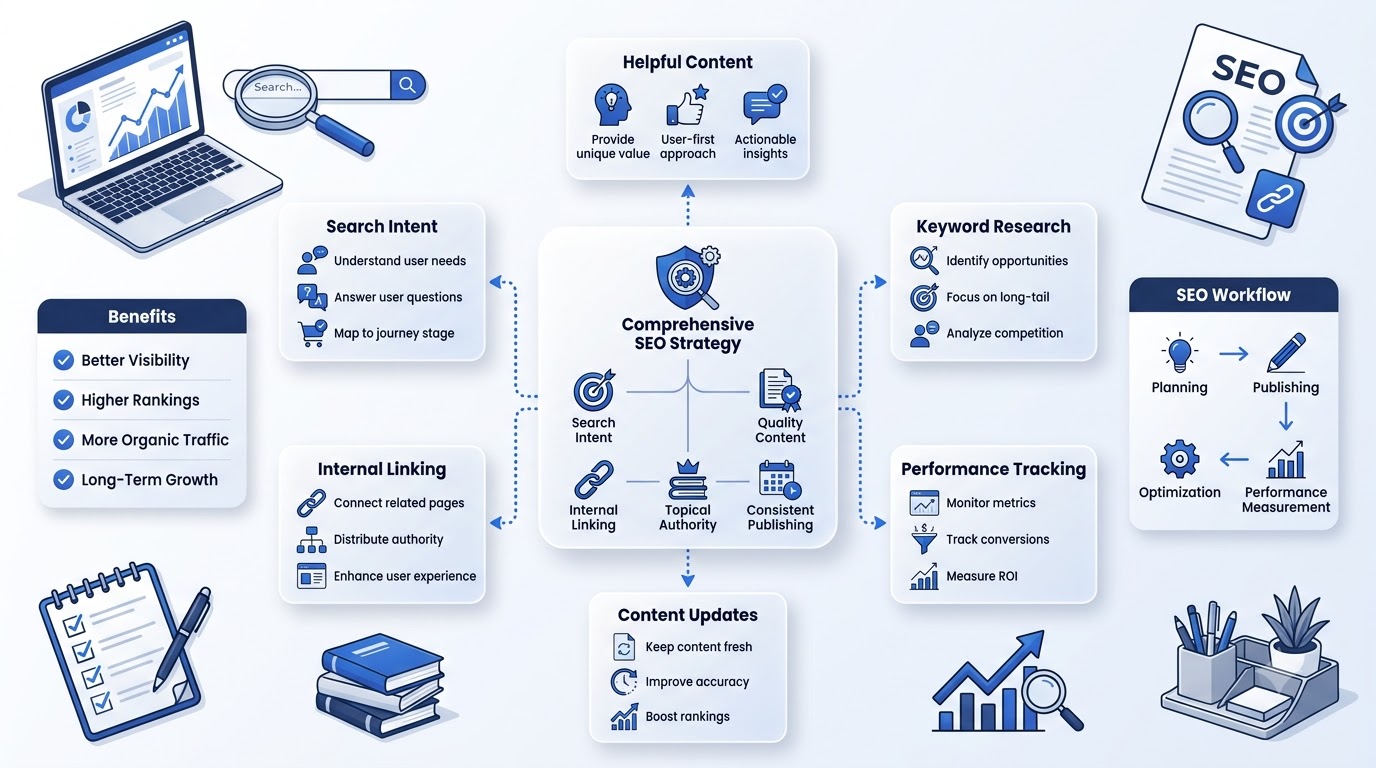
One blog rarely changes the rankings overnight, but blogging consistently can set the stage for momentum. Let's break down the actual technical details, because knowing why something works enables you to do it right:
Every quality blog post or article can:
- Rank for Multiple Keywords: A well-optimized blog post can rank for hundreds of related keywords. This helps websites capture search traffic from different variations of what your audience is looking for.
- Opportunities for Indexable Pages: Every quality post is a new doorway for Google to send traffic through. Plus, it opens a new opportunity to rank for a specific question your customer is typing into the search bar.
- Earn Backlinks: Things like original data, examples, and genuinely useful frameworks in your posts are what other sites actually want to link to, and then backlinks remain the strongest ranking signals.
- Generate Organic Traffic: Great content can keep bringing people back for months or even years after it's been published, unlike paid ads. For example, instead of writing “Best SEO Trends 2023”, write “The Ultimate Guide to SEO Trends” and then update it every year. Therefore, one evergreen article has the potential to generate qualified traffic for a long time.
- Answer Customer Questions: Blog content allows you to address the exact questions, concerns, and challenges your audience has at every stage of the buying journey. By answering their questions, businesses can build trust before a prospect ever contacts your business.
- Internal Linking: Each new post is a chance to link back to your service pages, product pages, and older posts. As a result, this creates a web of relevance that strengthens your entire site, along with the newest page.
- Great Website Engagement: Visitors will spend more time on your website, look at more pages, and come back to your business to look for more resources if the content is useful and interesting. These positive signals from users can help a website perform better overall.
- Fresh Crawl Signals: Search engines revisit active sites quite often. A blog that's updated regularly gets crawled more often than one that's gone quiet for six months.
- Strengthen Topical Authority: When you consistently publish around a connected set of topics, Google starts recognizing your website as a genuine authority in that space. It makes your business stand out from a random business with a blog tab nobody updates.
Optimizing For the AEO, GEO, and AIO Era
The real game changer in 2026 is the fact that posting blogs is no longer just about aiming to rank on Google’s results page. In today’s time, your content needs to be understood, trusted, and quoted by Google’s AI system or AI chatboxes like ChatGPT and Perplexity.
Your goal is to reach customers not just by search bars but also through other assistance your audience might use.
Here are some tips on how you can make your blog genuinely AI-friendly:
- Answer Clearly and Early: AI tools pull concise and direct answers. Open each section with a clear, factual statement before expanding into detail. This strategy focuses on the way an article structures each heading.
- Use Structured Formats: Tables, numbered lists, and FAQs are far easier for AI systems to extract and summarize accurately than long and unstructured paragraphs.
- Cut the Promotional Tone: Something like “We are the undisputed leader in travel content” gets overlooked by AI summarizers because it's a claim and not a fact. On the contrary, a line like “This guide is based on a 12-month publishing study tracking 188 posts” is more specific, verifiable, and far more likely to be trusted and cited by AI systems.
- Back Claims with Real Data: Statistics with clear sourcing build the kind of credibility both readers and AI models are trained to prioritize.
- Add Schema Markup: FAQ schema, Article schema, and Organization schema help both traditional search engines and AI crawlers to learn exactly what your content is about.
It is really important to understand that SEO, AEO (Answer Engine Optimization), and GEO (Generative Engine Optimization) aren’t separate strategies anymore. They work hand-in-hand on the same content with more precision and structure.
Blogging for SEO vs Blogging for AI Search
Both SEO and AI search optimization work on the same content, but they focus on optimizing different factors.
Let’s understand the differences so you can understand how to make content in your blog more effective:
| Factor | Blogging for SEO | Blogging for AI Search |
|---|---|---|
| Primary goal | To rank high and earn clicks. | Get cited or quoted inside the AI answer and AI snippets. |
| Unit of optimization | The page as a whole. | Each paragraph/sentence individually. |
| Ideal content shape | Longer and comprehensive pages that cover a topic in depth. | Dense, fact-rich and self-contained sentences that answer a question directly. |
| Success metric | Traffic, rankings, and conversions. | AI citation rate, brand mention frequency across AI answers. |
| What harms performance | Thin content, keyword stuffing, and weak site structure. | Filler paragraphs, buried facts, and unclear or unquotable phrasing. |
| Content style | Padded for length, since longer pages tended to rank on competitive keywords. | Typically, a 50-word paragraph with five real facts beats a 500-word paragraph with one. |
Despite the differences, both systems reward real experience, clear structure, and content built for people.
How Many Blog Posts Per Week for SEO Do You Actually Need?
There is no single number we can define. It totally depends on your business, industry, and available resources. But here is a realistic framework based on current data:
| Business Stage | Frequency to Post Blogs | Why? |
|---|---|---|
| New website/blog | 3-4 posts/week | Initially, a website needs volume to build topical authority and get indexed. |
| Growing business | 1-3 posts/week | Balances consistency with quality and resource limits. |
| Established, authority site | 2-4 posts/month | Focus shifts to updating and expanding existing content. |
As you can see, the more you grow, the less you need to post. So, if you're wondering how often you should blog for SEO, the honest answer is: enough to stay consistent. In parallel, business that stopped publishing entirely saw their organic traffic fall and slowly decline.
How Often Should You Update SEO Content?
To be honest, there is no fixed number. Your blog content should be regularly reviewed every three to six months to let blogging help SEO. Trending topics like AI, finance, and tech should be checked every one to three months, and evergreen topics can be reviewed every six to twelve months. On the other hand, product and commercial content needs quick checks at least every quarter, or even sooner if the pricing or offers keep changing.
The logic behind this is really simple. Content silently decays over time. If you leave a blog unmaintained for a long time, then the post will start to lose rankings, and you can lose around 15-30% of the traffic.
On the brighter side, HubSpot data revealed that posts get a traffic gain of an average of over 100%. This happens because the majority of the blog leads come from existing content rather than new posts.
Update your content sooner if you notice dropping traffic or rankings, outdated stats, broken links, or a competitor outranking the page.
Here is a breakdown of when different types of content need to be updated:
- News and Trend Posts: Since any factual change can quickly date them, it is recommended to update them on a weekly or monthly basis.
- Competitive or Commercial Pages: It should be done every three months, or sooner if traffic or rankings start to drop.
- Standard Blog Posts: Once every three to six months, or whenever statistics become outdated, or links stop working.
- Evergreen Posts: Every 6–12 months, mainly revisited when search intent itself shifts.
Do note that Google actively avoids content with "fake freshness". You cannot keep changing the date without substance. A real update should change a significant share of the actual content and not just the timestamp.
How Adomantra Can Help You Rank Higher?
Here at Adomantra, we take a dedicated approach towards making your content structured. We understand how blogging help SEO, GEO, and AEO systems. We work on not just chasing keywords but optimizing your content for both Google result pages and AI-generated answers.
Let's see how we work on your content to make it rank higher:
- We do comprehensive keyword research based on search intent.
- You get SEO, AEO, and GEO-optimized blog writing from us.
- We follow content cluster and topical authority strategies.
- Help you deliver AI-friendly content structured for Google AI Overviews and generative search.
- Leave regular content audits and updates to keep blogs relevant to us.
- Internal linking strategies that strengthen website architecture.
- We make sure to track performance using Google Search Console and analytics.
Adomantra can help you achieve that good traffic on your content and that high rank you are aiming for. We bring content that serves your audience efficiently.
A Wrap Up
So, does publishing more blogs improve Google rankings? We would say, only when “more” means “more strategic”. Apart from being consistent, producing well-researched content, and structuring the content for real people and AI, you should never forget your customers.
We urge budding marketers to publish with intention, keeping the frequency in mind. Believe us, the rankings will follow ultimately.
And if you have no idea where to start from, let Adomantra be your sustainable organic growth partner for strategic content marketing and SEO practices.
FAQs
Q1: Can blogging help SEO?
A: Yes! Blogs or articles are an excellent way to enhance SEO results. And if you've just started out showing up in the digital space, then you can start with publishing informative, keyword-rich articles to create indexable pages, attract backlinks, and build topical authority.
Q2: How to get 1000 views per day on a blog?
A: It requires a multi-channel approach. You are supposed to master proper keyword research to write high-value content, publish consistently to build a content library, and actively distribute your posts on targeted social media platforms or other communities like Reddit or Quora.
Q3: How much money per 1000 views on a blog?
A: A blog post has the potential to earn between $2 and $40 per 1,000 views if it relies solely on display ads, but that number can grow up to $100 to $500+ per 1,000 views by mixing in affiliate marketing, sponsored content, and digital products.
Q4: How to get higher SEO?
A: The six tried and tested ways include:
- Setting an SEO optimization strategy.
- Publishing relevant and authoritative content.
- Updating content occasionally.
- Having a link-worthy site.
- Optimizing the site for mobile and performing technical SEO.
- Rely on SEM, SEOx, and more.
Q5: Is 75 a good SEO score?
A: Yes, it is decent or average. It states that you have a solid technical foundation with basic optimizations in place.