Every young founder eventually hits this moment: what if I wake up every morning to new enquiries, website visitors, and potential customers, that too without spending thousands on Google Ads.
Sounds too good to be true? It isn't.
Since paid traffic isn't sustainable forever, the real question becomes: how to rank on Google without pouring money into ads every single month? While many people have their opinions that it is next to impossible, fortunately, it just takes strategy instead of a credit card.
This guide walks you through exactly how to build genuine, lasting visibility using organic SEO strategies with no ad account required.
Why Are Organic Rankings Still Worth It?
In a study, it was found that the top 3 organic results on Google capture 68.7% of all clicks combined, and position 1 alone earns more clicks than positions 3 through 10 put together.
This straight up means that the businesses ranking organically at the top aren't just getting “some” traffic. Instead, they’re getting the majority of it, for free, day after day, without paying for a single click.
Compared to paid ads, which stop working as soon as your money runs out. Organic rankings continue to grow once properly constructed. When you compare paid advertising and organic SEO side by side, as in the table below, the distinctions get even more obvious:
| Feature | Paid Ads | Organic SEO |
|---|---|---|
| Cost per click | Ongoing, per click | Free once ranked |
| Traffic after budget stops | Drops to zero | Continues |
| Trust with users | Lower | Higher |
| Time to results | Immediate | Weeks to months |
| Long-term ROI | Resets every campaign | Compounds over time |
However, if your goal is to build a business for the long term, learning how to rank higher on Google organically is one of the highest-leverage skills you can invest in early.
How to Get Your Website to the Top of Google: The Core Levers
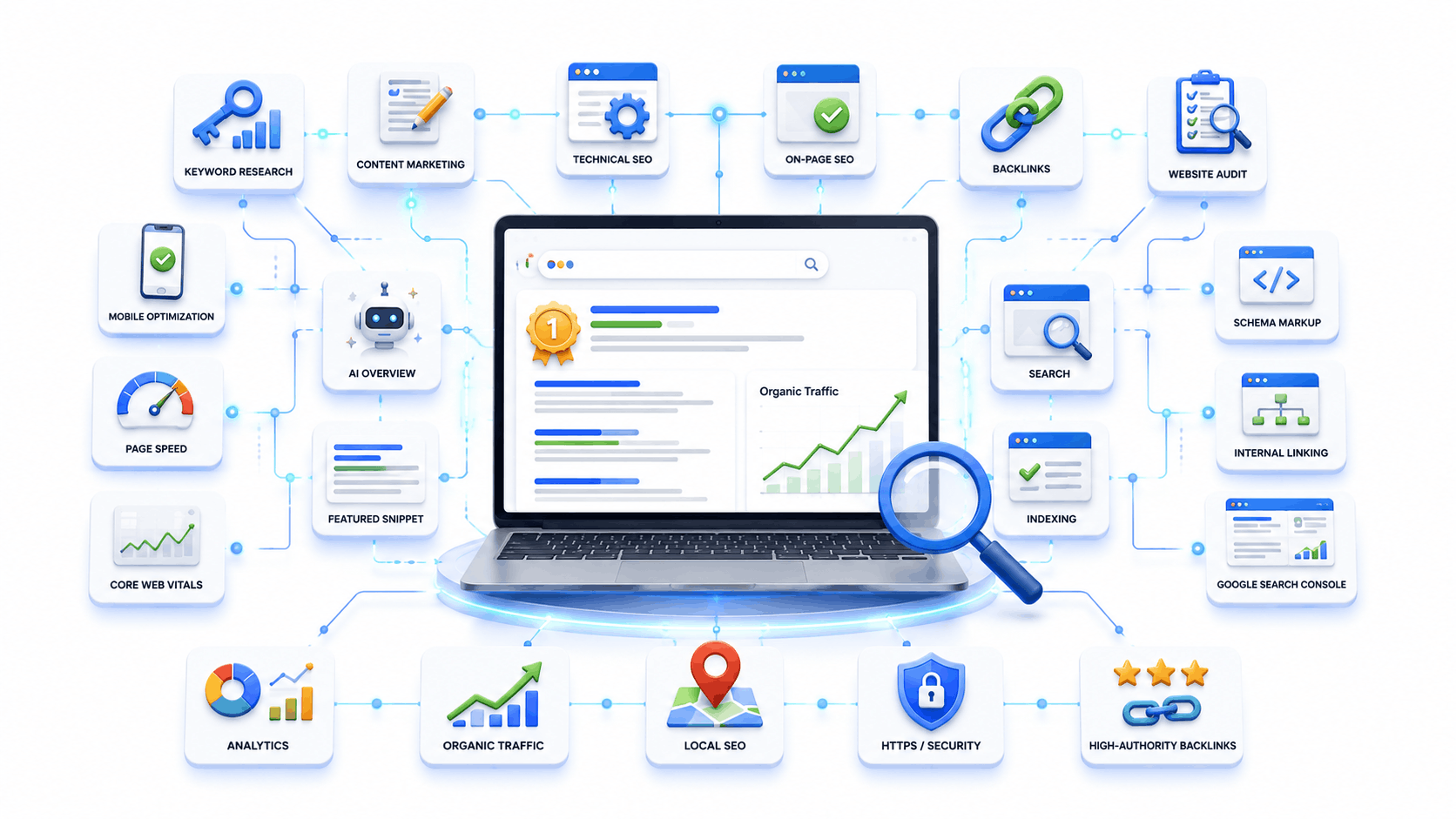
Ranking is a mix of several technical things working together. If you're wondering how to get your website to the top of Google, focus on these four pillars, as these are a few organic Search Engine Optimization strategies:
- On-Page Optimization: Make each page easy to understand for Google as well as for readers.
- Technical Health: Own a fast, mobile-friendly, and crawlable website.
- Content Depth and Relevance: Answer what people are searching for, rather than competing with others.
- Backlinks and Authority: Make other credible sites vouch for you.
And if you’ve missed one of these, our rankings will remain unchanged no matter how much effort you put into the others.
The Technical Foundation Google Actually Checks
Before Google can rank your page, it has to crawl it, render it, and index it. Surprisingly, many small businesses mostly fail at one of these steps without even knowing it.
Well, this is the layer most guides skip, but we are here to help you strengthen your technical checks if you are serious about how to rank on Google.
Think of Google's ranking process as a three-step process. If your page gets stuck at any stage, it may never reach the search results. Here is a table explaining what happens at each stage and the common issues that can prevent your page from ranking:
| Stage | What Happens | Common Failure Point |
|---|---|---|
| Crawling | Google bot discovers and reads your page | Blocked by robots.txt, orphaned page with no internal links |
| Indexing | Google stores the page in its database | Missing or incorrect canonical tag, “noindex” left on by mistake |
| Ranking | Google decides where the page shows up for a query | Weak content, poor technical signals, low authority |
Do check them practically; search “site:yourdomain.com” on Google. If a page you expect to see isn't listed, it likely isn't indexed. Result? No amount of content polishing will help until that is fixed.
Other than that, Core Web Vitals are Google's specific technical performance metrics, and they directly influence rankings:
- LCP (Largest Contentful Paint): How fast your main content loads, and you have to aim for under 2.5 seconds.
- INP (Interaction to Next Paint): How quickly your page responds to a click or tap. Usually, you should aim for under 200 milliseconds.
- CLS (Cumulative Layout Shift): How much your page visually “jumps” while loading. It must be under 0.1.
For example,
A site with a beautifully written blog post that scores “poor” on LCP because of an unoptimized 4MB hero image will often lose out to a plainer-looking competitor whose page simply loads faster. Compressing images, enabling browser caching, and using a lightweight theme are usually enough to fix this without hiring a developer.
Use Schema Markup to Improve Search Visibility
Schema markup is another layer that is worth knowing because you can’t just implement it blindly. Although adding FAQ schema, Article schema, or Local Business schema in JSON-LD format doesn't majorly affect the rankings positively, it does help Google's systems evaluate your content with precision. Consequently, this increases your odds of landing in rich results, featured snippets, and AI Overview citations.
Bonus Tip: You can use free tools like Google's Rich Results Test. It lets you check if your markup is actually valid before you rely on it.
Employ On-Page SEO
Here's a practical on page SEO checklist you can actually run through page by page:
- Title Tag: Title must include your primary keyword and must be written under 60 characters.
- Meta Description: It is written to earn the click, not just stuff keywords.
- One Clear H1: Must be logically aligned with structured H2s and H3s underneath
- URL: This must be short and readable. For example, yoursite.com/SEO-optimization-benefits, not yoursite.com/p=4821.
- Primary Keyword: Must appear in the first 100 words naturally.
- Internal Links: Connect the content to 2-3 related pages on your site.
- Images: It must have descriptive alt text (helps both accessibility and image search) and be served in compressed, next-gen formats like WebP.
- Page Loads: The actual time should be under 3 seconds on mobile, with Core Web Vitals in the “good” range.
- Canonical Tag: Should point to itself (or the correct master version, if the content exists in multiple places).
- Schema Markup: Must be added structurally and validated in JSON-LD format.
- No Orphaned Pages: Every important page has to be linked from at least one other page on the site so crawlers can find it.
Follow Long Tail Keywords Strategy
If you're a small business competing against big, established brands, going after broad terms like “how to rank on Google” is a losing battle from day one. Then how to increase organic traffic? This is exactly where a solid long-tail keyword strategy changes everything.
For example, you can use a long-tail keyword like this “how to rank on the first page of Google”.
Long-tail keywords are more specific search phrases. These keywords deliver 3 to 5 times higher CTR and better conversion rates compared to short terms.
A technical way to evaluate them is to check search intent and keyword difficulty. If you have a new site, prioritize keywords with a KD under 20-30 and clear commercial or transactional intent.
Get Backlinks For Free
Backlinks are one of Google's strongest trust signals that indicate that you have been there for a while and are trusted by many people. And the fact that you don’t need a big PR budget to earn them. Here's how to get backlinks for free:
- Guest Posting: Provide content on blogs that are relevant to your niche in return for a backlink to your website.
- HARO-Style Journalist Requests: Respond to reporters who are looking for expert quotes, which often earn links from major publications.
- Local Business Directories and Industry Listings: Many of them are free and genuinely boost local SEO.
- Original Data or Small Studies: Publish something genuinely useful, and other sites will naturally want to cite and link to it.
- Broken Link Building: Find dead links on relevant sites and offer your content as the replacement.
Before you start chasing links, there is another technical distinction worth knowing, i.e., dofollow vs nofollow. Dofollow links pass “link equity” and directly help rankings. On the other hand, nofollow links (common on forums, comments, and some directories) don't pass ranking authority but can still drive referral traffic and brand visibility.
How to Increase Organic Traffic Beyond Just Ranking?
Ranking is only half the job. Here's how to increase organic traffic once you've started climbing:
Update Old Content Regularly: A post that ranked well a year ago can lose its position if it's not refreshed with current information.
Improve Internal Linking: Every new post should link to older, related posts, and vice versa. It can spread the authority across your site.
Target Featured Snippets: Answering questions in a clear, concise format with short paragraphs, numbered steps, or tables increases your chances of being pulled into Google's answer boxes, i.e., “featured snippet”. As a result, this can drive additional clicks even from lower positions.
Build Topic Clusters, Not Isolated Posts: A group of connected articles around one theme signals to Google that you have deeper expertise than a single standalone piece ever could.
Optimizing for the AEO and GEO Era
Gone are the days when rankings were about blue links. Now the competition is about being the answer AI tools like Google's AI Overviews and other assistants choose to cite.
Even a simple tweak or adjustment to the content makes it far more AI-friendly.
Since users no longer rely only on traditional Google search results. Many now ask questions through:
- Google AI Overviews
- ChatGPT
- Gemini
- Perplexity
- Microsoft Copilot
However, to make your content relevant for AI, rely on the following practices:
Answer the main question directly in the first 2-3 sentences of each section rather than elaborating it for the sake of extra information.
Use structured formats, including tables, numbered steps, and FAQs, as these are easier for AI systems to extract accurately.
Try to avoid vague or promotional language. For example, a line like “We are the number one choice for SEO in India” has a higher chance of being easily ignored by both readers and AI summarizers because it's unverifiable.
A specific line like “This strategy helped a Delhi-based bakery move from page 3 to page1 in 90 days” is the kind of concrete, checkable detail that earns trust and citations.
Common Technical SEO Mistakes: Know How to Fix Them
Reading about Core Web Vitals and schema is one thing, whereas knowing what's actually broken on your site is another. Below, we’ve provided a diagnostic table built around free tools so you can find and fix the most common issues yourself:
| Issue | How to Spot It | The Fix |
|---|---|---|
| Duplicate title tags across pages | GSC ? Pages report, or Screaming Frog's “PageTitles” tab flags duplicates | Rewrite each title to be unique and include the page's specific target keyword |
| 404 broken pages | GSC ? “Not Found (404)” under Pages, or crawl with Screaming Frog | Fix the link, restore the page, or set up a 301 redirect to a relevant live page |
| Redirect chains (A?B?C instead of A?C) | Screaming Frog's redirect report | Point the original URL directly to the final destination to avoid diluted link equity and slower load times |
| Missing or duplicate meta descriptions | GSC or Screaming Frog meta description audit | Write a unique description for every indexed page |
| Thin or near-empty indexed pages | Low word count + low engagement time in Google Analytics | Expand with genuinely useful content, or set to “noindex” if the page serves no real search purpose |
| Slow LCP from unoptimized images | PageSpeed Insights | Compress images, convert to WebP, enable lazy loading below the fold |
| Mobile usability errors | GSC ? Mobile Usability report | Fix via responsive CSS and check for text too small to read and buttons placed too close together |
| Keyword cannibalization | GSC ? Performance ? filter by query, check if multiple URLs appear | Consolidate the weaker page into the stronger one, or clearly differentiate their target keywords |
| Invalid or missing schema markup | Google's Rich Results Test (a free tool) | Fix the flagged JSON-LD errors or add FAQ/Article schema where it's currently missing |
| Crawl budget wasted on low-value URLs | Server log file analysis, or GSC's Crawl Stats report | Block filter/parameter URLs via robots.txt, or noindex low-value pages so crawlers focus on pages that matter |
We’ve tried them personally, and believe it, running through even the top three or four of these once a quarter catches most of the silent issues that cap your rankings without ever reflecting an obvious error.
Free SEO Tips That Deliver Long-Term Results
One of the most common myths in digital marketing is that SEO is expensive. While professional SEO services require some sort of investment, there are plenty of free SEO tips that can help improve your visibility. And you never know, it might turn your visitors into customers.
Here are a few of them:
- Optimise your Google Business Profile.
- Create helpful content regularly.
- Improve internal linking to high-performing blogs.
- Optimise existing pages.
- Answer common user questions by adding FAQ sections to your pages.
- Focus on search intent.
- Add relevant external links to authoritative sources.
This overlap between good organic SEO strategies and AI-search readiness is exactly why quality content now works harder than it used to.
How Adomantra Can Help You Rank on Google's First Page?
Ranking on Google's first page isn't about luck; it's about having a strategy that aligns with Google's evolving algorithms and user expectations. At Adomantra, the team has relevant knowledge and can execute these strategies while running your actual business in parallel.
Adomantra’s organic SEO team can help you handle the full picture. You can rely on us for on-page optimization, technical audits, long-tail keyword research, ethical backlink outreach, and content built for both traditional Google rankings and AI-driven search.
Therefore, Adomantra is designed to provide the kind of long-term, compounding growth that you're looking for if your objective is to rank a website on the Google first page without using a monthly ad budget.
Final Thoughts
Getting on the top of Google isn’t a one-time fix. It's the result of a steady and correct groundwork. You need to focus on having a technically healthy site, content that answers people’s queries, and enough trusted backlinks to back the site up. Overlooking any of these can affect your ranking heavily.
The businesses that eventually figure out how to rank on Google without ad spend usually didn't do anything fancy. They just stay consistent about fixing their Core Web Vitals, picking up backlinks the honest way, and cleaning duplicate tags. It is important to publish content that helps people genuinely.
Frankly, none of this happens overnight. So if you're serious about how to rank higher on Google, start with the technical checklist, pick 2 or 3 long-tail keywords to go after first, and build from there. Or you can let our team at Adomantra handle the audits, content, and link-building for you, so you can focus more on running your business.
FAQs
Q1: What is the average time it takes to appear on Google's first page naturally?
A: Ranking organically isn't about overnight success. It takes around a few months. Plus, it depends on how much competition there is, the age of your website, and how frequently you are publishing content and building backlinks.
Q2: Is SEO still worth it with AI Overviews and chatbots answering questions directly?
A: Yes, and in fact it matters more now. Clear and well-structured content that directly answers questions is exactly what gets pulled into AI Overviews and cited by AI tools like ChatGPT or Perplexity.
Q3: What's the difference between on-page SEO and technical SEO?
A: On-page SEO covers things like title tags, headings, and keyword placement within your content. Technical SEO covers the behind-the-scenes health of your site, such as crawlability, indexing, page speed, and Core Web Vitals. You need both for Google to rank you well.
Q4: Can I rank on Google's first page without any backlinks?
A: This is only possible with long-tail keywords if there is low competition. However, backlinks are one of the strongest trust signals in Google searches. There are many ways you can get links for free, including “broken link building” and “guest posting”.