Gone are the days when the biggest worry was ranking on page 1 of Google. Those days aren't coming back. In 2026, the search landscape is completely based on traditional search (Google, Bing), generative AI search (ChatGPT, Claude, Perplexity), and answer engines (Reddit, Quora integration, direct answer APIs).
However, the ugly truth today is that if you are only optimizing for Google, then you are leaving 40% of your potential customers in the dark. Why is it so? Because people these days use ChatGPT to research solutions, ask Claude for recommendations, and get answers from AI without ever clicking a link.
Due to this reason, relying on traditional SEO in 2026 is like trying to catch fish with only a net while your competitors use nets, fishing rods, and more.
Meanwhile, LLM SEO services, AI SEO services, and the emerging discipline of generative engine optimization came to the rescue. This guide clearly mentions what has changed with no bluffs, along with an example for easy understanding.
Fun Fact : OpenAI and Google increasingly reward content that clearly answers questions with factual, structured information.
What Each Channel Actually Is: New Era of SEO
Imagine someone is researching “best project management tools for remote teams”. And if we look at the old pattern, in the 2020s, it would be like they'd Google it, click links, read blog posts, compare, and then decide.
Being a marketing solutions provider, the optimization goal back then was to rank in positions 1- 3 on Google for “best project management tools” or for some other keyword.
In 2026, marketers are approaching a multi-channel search approach. We’ve explained this by dividing the strategy into the following three scenarios:
Scenario 1: The Google Searcher
40% of users search “best project management tools for remote teams” on Google.
- Now your SEO optimization matters here.
- Meta description, page speed, backlinks, all of them are relevant.
Scenario 2: The ChatGPT Asker
35% of users ask ChatGPT: “What's the best project management tool for my remote team of 12 people? And my budget is ?5,000/month”.
- Your LLM SEO services and generative engine optimization matter here.
- ChatGPT doesn't crawl your website as Google does.
- It extracts information from training data.
- If you're not cited in ChatGPT's training data or didn't get indexed by their crawler, you're simply invisible.
Scenario 3: The Perplexity Explorer
15% of users use Perplexity AI with citations: For example, a person might search for “Show me project management tools that fit my criteria”.
- Perplexity indexes differently from Google.
- It prioritizes recent articles and official product pages.
- Answer engine optimization becomes crucial here.
Instead of showing a list of websites like Google, Perplexity provides a summarized answer and cites a trusted source.
This means your content should be fresh, regularly updated, published on a trustworthy website, well-structured with clear headings + factual information, and easy for AI to understand and reference.
This is exactly the role of answer engine optimization.
Scenario 4: The Community Researcher
The remaining 10% of users ask on Reddit: “What tool do you use?” in r/RemoteWork or r/ProjectManagement.
- They get direct answers from real users.
- No blog post matters here.
- But if your product isn't being discussed organically, you've lost this channel entirely.
Now, the harsh reality here is that you may have lost 75% of potential customers if you only optimized for Scenario 1.
Understanding the Three Pillars: SEO vs GEO vs AEO
At this point, the terminology might get confusing because everyone uses these words differently. Adomantra has a different way of seeing them. Let's clarify what we actually mean:
Pillar 1: SEO (Search Engine Optimization)
Search Engine Optimization simply means optimizing your website for Google's algorithm to rank higher in search results. Here, the crawler works behind the scenes.
First, it visits your website, analyzes over 200+ ranking factors (including content, links, speed, mobile-friendliness, etc.), ranks you against competitors for specific keywords, and checks users' click-through to your site.
Although this is still necessary, it is no longer sufficient. Let’s understand with an example:
|
Article Title: “15 Best Project Management Tools in 2024”. Meta Description: “Discover the top 15 project management tools for teams. Compare features, pricing, and benefits. Find the perfect tool for your needs”. Keyword Focus: “best project management tools”. Strategy: Long-form content (3,000+ words), backlinks, keyword optimization. |
Now, the reason why this is not sufficient today is that you’re invisible in ChatGPT, Claude, or Perplexity unless you’re specifically cited. Moreover, the generative engine no longer follows traditional SEO rules. Overall, you can rank #1 on Google but be completely omitted from LLM responses.
Pillar 2: Generative Engine Optimization (GEO)
The practices of GEO differentiate by optimizing your content and strategy so that Large Language Models (LLMs) cite, reference, and recommend your business.
It works like this:
- LLMs like ChatGPT, Claude, and Gemini are trained on massive text datasets.
- AI engines generate responses based on patterns in the training data.
- If your content is authoritative and well-indexed, LLMs will cite you.
- Users see your recommendation WITH context, not just a link.
The key difference, as you can see here, is that GEO is about being cited as a source of truth, rather than ranking on SERPs.
Here is an example of GEO-optimized content:
|
Article Title: “Project Management Tools Comparison 2026: Features, Pricing, Real User Reviews”. Structure: Write content with clear sections, data points, and honest negatives because AI prioritizes real content over quantity of drafts. Example of Format:
Real Data: Research hard and try to add the latest reviews, user testimonials, ROI metrics, and statistics from authoritative websites. Authority Signals: Author credentials, years in industry, and case studies. Key point: This article is written for LLMs to cite, not just for Google to rank. |
Now, if somebody asks ChatGPT about the best project management tool for remote employees, ChatGPT might respond, “For remote teams, XYZ is highly regarded for task management with distributed teams (as noted in their 2025 case studies). Another strong option is ABC, which specializes in visual workflows. According to recent reviews on G2, both tools have 4.5+ ratings from 5,000+ users.
The catch here is: ChatGPT didn't pull this from a specific blog post. It synthesized information from multiple sources. If your case studies, reviews, and data are prominent in training data, you get cited.
Pillar 3: Answer Engine Optimization (AEO)
AEO refers to content that can provide direct answers in search results and AI-generated responses. So, what happens behind the scenes is that search engines and AI platforms extract information from web pages to provide direct answers.
The common examples are featured snippets on Google, answers in Google Knowledge panels, and Reddit threads cited in responses.
Here is a quick comparison of not AEO-friendly and AEO-optimized content:
|
Not AEO-friendly “Project management tools have revolutionized how teams collaborate in the modern workplace. The evolution of project management has been significant. Many organizations struggle with coordination and communication challenges…” [300 words of introduction before answering the question] |
|
AEO-optimized Content Q: What is project management software? A: Project management software refers to a digital tool that helps teams organize tasks, track progress, set deadlines, assign responsibilities, and communicate in one centralized platform collaboratively. Examples: Asana, Monday.com, Jira, Trello, ClickUp, etc.Key Benefits:
|
Did you see the difference? AEO believes in giving direct answers rather than building hypothetical stories before coming straight to the point. The benefits of doing so include:
- 31% of searches now return AI-generated summaries instead of traditional results.
- Direct answers get 70% of clicks before users even scroll.
- Featured snippets = more visibility.
- Structured data = easier for AI to cite you.
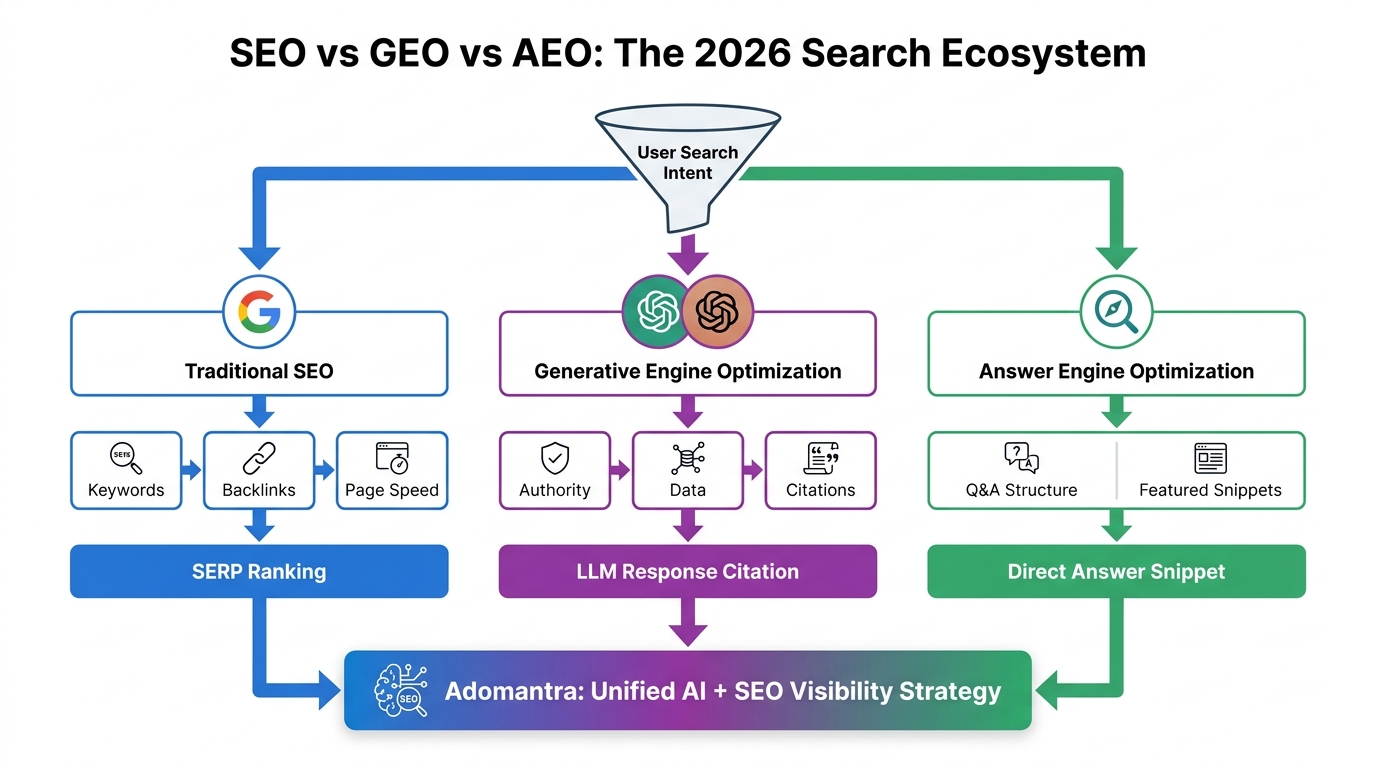
SEO vs GEO vs AEO: Which One Matters?
Here's a side-by-side comparison for clear understanding:
|
Factor |
Traditional SEO |
Generative Engine Optimization |
Answer Engine Optimization |
|
Ranking Metric |
Position on the search results page |
Citation in LLM responses |
Appearance in answer snippets |
|
Traffic Driver |
Click-through from SERP |
Direct mention and context |
Featured snippet click |
|
Content Length |
2,000 - 3,000+ words ideal |
Quality over Quantity (1,500+ suffices) |
Concise and structured data |
|
Key Focus |
Keywords, backlinks, page speed |
Authority, factuality, recent data |
Direct answers, Q&A structure |
|
Update Frequency |
Monthly-quarterly crawls |
Continuous (training on new data) |
Real-time indexing |
|
Data Freshness |
Important but not critical |
CRITICAL (LLMs favor recent sources) |
CRITICAL (current information) |
|
Trust Signal |
Backlinks, domain authority |
Author credentials, data accuracy |
Source attribution, reviews |
|
Time to Impact |
3-6 months |
4-8 weeks (for citations) |
1-2 weeks (for indexing) |
|
Best For |
Evergreen content, brand building |
Thought leadership, product positioning |
FAQ pages, specific answers, data |
|
Example Success |
Blog ranking #1 for the keyword |
ChatGPT is recommending your product |
Google is showing your answer snippet |
Why Your Current SEO Isn't Working and How Adomantra Can Help?
Let's talk about what's actually happening to businesses and what Adomantra is going to fix for that specific problem:
Problem 1: Google Traffic Is Plateauing
It's been years since you’ve worked hard to rank well and get traffic, but lately, your organic traffic growth has been declining. Moreover, your brand is competing against 15+ pages for the same keywords; Google is showing AI overviews, which have reduced clickthrough rates; and you’re still investing ?2,00,000/month in SEO for 5,000 monthly visitors.
This indicates that you are unaware of what has changed. Adomantra will come in and employ LLM SEO services. This way, we will capture the potential customers before they even get to Google.
Problem 2: ChatGPT Is Your New Competitor
When someone asks ChatGPT, “Should I switch from Tool X to Tool Y?”, your answer should be the answer they hear from ChatGPT. Now that you’ve tried hard and hired writers to produce more content, you're still not visible in AI. However, you become desperate to see growth.
Now, the first thing is to be patient because ChatGPT's training data is 6-12 months old in some cases. So, you have to build authority with your content for the specified period of time. And if you haven't built authority or optimized for LLM citation, you're invisible.
In a similar situation, Adomantra will create content that is not only optimized for Google but also structured for AI-powered search platforms.
|
Real World Example: A SaaS company with a ?2L/month SaaS tool, 8,000/month traffic from Google, and 0 mentions in ChatGPT comes to us asking that they want to appear in AI. The team of Adomantra worked for 8 weeks to optimize their site for the generative engine. The traffic went up to 8,500 visitors per month (+6%), the brand started appearing in 480+ AI-generated responses every month, and the total influenced traffic is 9,700 monthly. |
The takeaway? Adomantra didn't replace traditional SEO nor reduce their Google investment; we just enhanced their existing website with LLM SEO services, and the rest is history…!
Problem 3: You're Missing Answer Engine Traffic
Google introduced AI Overviews in 2023. And in 2026, they've only gotten more aggressive. When Google generates an answer from 5 sources and shows it directly, if you’re not one of those 5 sources, you’ll get nothing.
How We Help You Rank Across AI Platforms: A Clear Roadmap
This section is where theory meets execution. Here is what we do actually:
Phase 1: Multi-Channel Audit (Week 1-2)
We analyze:
- Current SEO Status: Where do you rank on Google for your top 50 keywords?
- LLM Visibility: How often are you cited in ChatGPT responses? (We run 200+ queries to find out)
- AEO Opportunity: Which questions should you own via answer snippets?
- Content Gap: Where is your content failing for AI platforms?
Phase 2: LLM Optimization for Websites (Weeks 3-8)
We restructure your content for three audiences simultaneously:
For Google (SEO):
- Keyword optimization.
- Backlink strategy.
- Technical SEO.
- User experience.
For ChatGPT, Claude, Gemini (GEO):
- Rewrite for authority and citability.
- Add data-rich comparisons.
- Build author credentials.
- Update all outdated information.
- Create structured data for LLM parsing.
For Perplexity, Google AI Overviews (AEO):
- Answer-first content structure.
- FAQ optimization.
- Featured snippet targeting.
- Direct answer formats.
Phase 3: Authority Building (Weeks 9-16)
At this stage, we don’t just optimize content; we build you as a source that AI wants to cite. Here is how:
- Get your content featured in high-authority publications (helps with training data inclusion).
- Build your author profile across AI-native platforms.
- Create original research that LLMs can cite.
- Generate structured data that tells AI, “This person/company is an expert”.
Phase 4: Continuous Monitoring and Adaptation (Ongoing)
Unlike Google (which updates quarterly), LLMs update continuously with new training data.
What we monitor includes:
- Monthly AI search optimization tracking for AI SEO services.
- Performance in Perplexity vs Claude vs ChatGPT.
- Changes to your LLM visibility when training data updates.
- Emerging keywords in AI queries.
The Bottom Line
In summary, we have to say that your potential customers are not just searching on Google. Instead, they're asking questions on ChatGPT, Gemini, Claude, Perplexity, and other AI-powered platforms. And that’s exactly where you have to show up.
Meanwhile, you don’t need to replace your existing SEO strategy completely. You have to evolve and partner with Adomantra to put mindful and results-oriented strategies in place.
We will combine LLM SEO services, generative engine optimization, answer engine optimization, and AI SEO services so that your business can improve its visibility across both traditional search engines and AI-driven answer platforms.
Till then, embrace what you’ve got because the majority of people still land on Google for their queries.
Frequently Asked Questions
Q1: What are LLM SEO services?
A: LLM SEO services focus on optimizing your website and content in a way that AI platforms like ChatGPT, Gemini, Claude, and Perplexity can understand, trust, and recommend your business in their responses.
Q2: How can I rank on ChatGPT?
A: To get cited in ChatGPT responses, you have to work hard to become a primary source, build author authority, and create data-rich content
Q3: How long does it take to see results from AI SEO services?
A: Actual results vary depending on your website's authority, competition, and content quality. If you have all of them in place, improvements may become visible within a few weeks. And if building an AI authority takes long-term then the results will take several months through consistent optimization and content updates.
Q4: Can small businesses benefit from LLM SEO services?
A: Yes, why not! Small businesses can also compete by publishing high-quality, niche-focused, and trustworthy content. And to see quick results, partner with Adomantra, as we will implement the right AI optimization strategy.