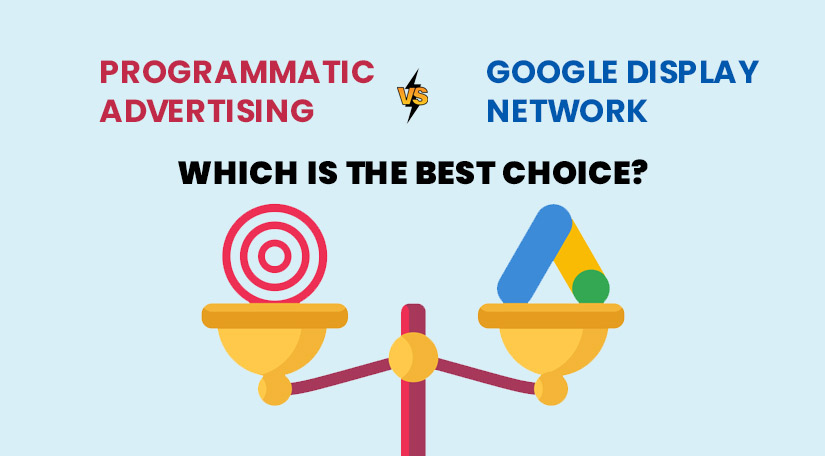
Programmatic Advertising and Google Display Network (GDN) are two of the most powerful tools in any digital advertising strategy. Both deliver impressive results, both command significant budgets, and both have evolved dramatically in 2026 — which is precisely why choosing between them has become more nuanced and more important than ever.
This is a question every serious digital advertiser faces, and the answer is not as straightforward as it once was. Internet advertising is a specialist's game — and the right choice between Programmatic and GDN depends on your objectives, audience, budget, and the sophistication of your targeting requirements. This is where the expertise of a seasoned digital marketing agency like Adomantra makes the difference.
We bring you a complete, updated 2026 insight into both these digital advertising platforms — their strengths, limitations, key differences, and which delivers the best results for different advertising goals. Read through the comprehensive analysis below to make a confident, informed decision for your next campaign.
Quick Overview of Programmatic Advertising and Google Display Network
What is Programmatic Advertising?
Programmatic Advertising is the use of Artificial Intelligence, machine learning, and automated bidding technology to buy and place digital advertising in real time. Rather than negotiating deals manually with individual publishers, programmatic systems evaluate millions of available ad impressions per second and purchase the most valuable ones automatically — based on audience data, targeting criteria, and campaign objectives.
Programmatic digital advertising encompasses display ads, video ads, native ads, connected TV (CTV), digital audio, and ads running across social networks including Meta, TikTok, and YouTube. In 2026, programmatic advertising accounts for over 90% of all digital display advertising globally — making it the dominant infrastructure of the modern internet advertising ecosystem.
Inventory acquisition in the programmatic ecosystem is done through four primary deal types:
- Open Auctions (RTB): Any eligible buyer can bid on available impressions in real time
- Private Marketplaces (PMPs): Invitation-only auctions with premium publishers for brand-safe, premium inventory
- Preferred Deals: Fixed-price arrangements giving specific buyers priority access to publisher inventory
- Programmatic Guaranteed: Reserved inventory at a fixed CPM with guaranteed delivery — combining the benefits of direct deals with programmatic automation
This diversity of deal structures ensures complete transparency between advertisers and publishers — and gives sophisticated buyers the flexibility to optimise for reach, quality, cost, or a combination of all three. Learn more about how programmatic advertising services work at Adomantra, or read our in-depth guide on what programmatic advertising is and how it works.
What is Google Display Network (GDN)?
Google Display Network (GDN) is Google's proprietary advertising network — an assemblage of over 35 million websites, apps, and videos where Google Display Ads can appear. With a reach covering approximately 90% of global internet users, GDN is one of the largest digital advertising networks in existence and remains an extremely compelling proposition for brands focused on broad awareness and cost-efficient reach.
GDN operates within Google's ecosystem — managed through Google Ads (formerly AdWords) and Google Ad Manager. Advertisers access GDN inventory through Google's own demand-side platform, and targeting is powered primarily by Google's first-party data from Search, Maps, YouTube, Gmail, and Chrome — one of the richest audience data sets available to any advertising platform.
Inventory in GDN is represented by ad units — designated spaces on websites, apps, and videos within Google's network that publishers have made available for advertising. These placements range from banner ads on news websites to video pre-rolls on YouTube and interstitial ads in mobile apps.
Comparison Between Programmatic Advertising and Google Display Network in 2026
Digital advertising in 2026 has a diverse landscape where both Programmatic Ads and Google Display Ads share common capabilities while each brings unique strengths to the table. Here is a comprehensive comparative analysis to help you make the right choice based on your advertising budget and objectives.
| Competition Benchmarks | Programmatic Advertising | Google Display Network (GDN) |
|---|---|---|
| Basics | Automated buying and placement of ads across multiple exchanges and publishers using AI and RTB technology. | Focuses on the format and placement of ads within Google's own ecosystem of websites, apps, and videos. |
| Inventory Accessibility | Accesses GDN inventory plus thousands of independent exchanges and publishers globally — not limited to any single ecosystem. | Accesses Google's 35M+ site network — extensive within its ecosystem but limited to publishers enrolled in Google's network. |
| Technology Used | AI-powered algorithms track ad impressions via multiple ad exchanges and DSPs in real time with millisecond decision-making. | Uses Google's first-party data (Search, Maps, Gmail, YouTube) and contextual signals to target and track campaigns. |
| Click-Through Rate (CTR) | Average CTR ~0.08% — lower individual CTR but optimised for audience quality and conversion, not just clicks. | Average CTR ~0.46% — higher click rate driven by Google's intent data and the familiarity of Google's ad placements. |
| Ad Formats | Display, video, HTML5, rich media, native, CTV, digital audio, DOOH, app ads — the broadest format range available. | Display, video (YouTube), HTML5, rich media, responsive, app ads — comprehensive but limited to Google-supported formats. |
| Tracking Speed | Real-time bidding allows tracking results within minutes — enabling faster optimisation and campaign adjustments. | Google Ads campaign statistics typically update every few hours — occasionally taking up to 24 hours for full data visibility. |
| Settlement Model | Flexible — fixed fees available for CPM, CPA, and CPC depending on deal type. Expenses can be optimised to minimise CPA/CPC. | CPM-based (each view priced individually) but expenses can be optimised within Google's system to reduce effective CPA or CPC. |
| Audience Targeting | Audience segments from multiple first-party and third-party data sources — including CRM data, contextual, and behavioural signals. | Powered by Google's first-party intent data — extremely powerful for audiences actively using Google Search, Maps, and YouTube. |
| Minimum Budget | Typically higher entry threshold — best value at budgets of ?50,000/month or above for meaningful scale. | Lower minimum budget — accessible to smaller advertisers with ?10,000–15,000/month starting budgets. |
| Complexity | Higher complexity — requires specialist knowledge or a managed service for optimal results. | More accessible — Google Ads interface is designed for self-serve use by non-specialist advertisers. |
Programmatic vs GDN — A Deeper Comparison
#1. Fundamentals of Ad Buying
Programmatic advertising follows the core principle of automated purchasing and real-time placement of ads across a fragmented, multi-publisher landscape. Google Display Network, in contrast, focuses on the format and placement of ads within its own curated ecosystem of websites and apps. Programmatic is platform-agnostic; GDN is Google-native.
#2. Inventory Accessibility
Programmatic advertising gives advertisers access to GDN inventory and takes them far beyond — reaching thousands of independent publishers, premium content environments, connected TV platforms, and niche digital properties that Google's network does not include. GDN, on the other hand, offers access to Google's 35 million+ site and app network, which spans virtually every content category and demographic — a genuinely vast ecosystem, though limited to publishers within Google's monetisation platform.
#3. Technology and Tracking
Programmatic advertising uses AI-powered algorithmic software to track the sale and placement of digital ad impressions via multiple ad exchange platforms simultaneously — processing millions of decisions per second. Google Display Ads use Google's first-party data from its core products (Search, Maps, Gmail, YouTube, Chrome) to track user behaviour and inform targeting. In 2026, Google's first-party data advantage is significant given the progressive restriction of third-party cookies across browsers.
#4. Click-Through Rate (CTR)
The average CTR for Programmatic advertising is approximately 0.08%, while Google Display Ads show an average CTR of approximately 0.46%. This gap requires context: GDN's higher CTR is driven partly by Google's superior intent signals (users who searched for your category are more likely to click a related ad). Programmatic's lower individual CTR is offset by its ability to optimise for conversion outcomes — reaching users at multiple touchpoints and across more diverse environments. CTR alone is not the right metric for evaluating either platform's true performance.
#5. Ad Formats
GDN supports video ads, text ads, HTML5 ads, rich media, and app ads. Programmatic advertising takes the lead with the broadest format library available — additionally supporting native advertising, connected TV (CTV) pre-rolls, digital audio ads, digital out-of-home (DOOH), and advanced rich media formats. For brands that want to reach audiences across every screen — including streaming TV — programmatic is the only option that delivers true omnichannel presence.
#6. Campaign Tracking Speed
Real-time bidding in programmatic advertising enables tracking results within minutes of launch — allowing advertisers to identify underperforming placements, adjust bids, and reallocate budget almost immediately. Google Display Ads provide campaign statistics that typically update every few hours and sometimes take up to 24 hours for complete data visibility. For fast-moving campaigns or time-sensitive events, programmatic's real-time feedback loop is a meaningful advantage.
#7. Settlement and Pricing Flexibility
Google Display Network uses CPM as its primary settlement model, though advertisers can optimise within their campaigns to reduce effective CPA or CPC rates. Programmatic advertising offers significantly more flexibility — with fixed fees available for CPM, CPA, and CPC depending on the deal type — and the ability to optimise ad spend across multiple publishers and deal structures simultaneously to minimise cost per outcome.
2026 Update: Privacy-First Advertising and What It Means for Both Platforms
In 2026, the digital advertising landscape has been reshaped by privacy regulations and the evolution of cookie-based tracking. Understanding how each platform adapts is critical for choosing the right approach.
Programmatic Advertising in 2026: The programmatic ecosystem has adapted to privacy changes through several mechanisms — contextual targeting (serving ads based on page content rather than user identity), first-party data activation (advertisers using their own CRM and customer data as targeting inputs), cohort-based audience models, and privacy-safe data clean rooms that enable audience matching without exposing individual user data. Understanding the evolution of DSP and SSP platforms explains how these privacy-safe mechanisms are implemented across the programmatic supply chain.
Google Display Network in 2026: Google has introduced its Privacy Sandbox initiative — a suite of privacy-preserving technologies designed to replace third-party cookies within Chrome. Google's first-party data advantage (from Search, Gmail, Maps, and YouTube) has become even more significant as third-party data availability has declined across the industry. For advertisers, GDN's access to Google's intent-rich first-party signals is increasingly valuable in a privacy-constrained environment.
Both platforms have adapted — but programmatic's flexibility and access to diverse data strategies gives sophisticated advertisers more tools to navigate the privacy transition effectively.
When to Choose Programmatic Advertising
Programmatic advertising is the stronger choice when:
- You need to reach audiences across multiple platforms, publishers, and environments beyond Google's ecosystem
- You want omnichannel presence — spanning display, video, CTV, audio, native, and DOOH from a single campaign
- Your brand requires premium, brand-safe inventory through private marketplace deals with specific publishers
- You have first-party customer data that you want to activate as custom audience targeting segments
- You need real-time campaign optimisation and minute-by-minute performance visibility
- Your budget is sufficient to justify the complexity and management overhead (typically ?50,000+/month)
- You want to reach audiences on Connected TV platforms like JioCinema, Hotstar, or Sony LIV alongside digital display
The rise of attention-based buying in programmatic advertising also means that sophisticated buyers can now target ad placements where audiences are most actively engaged — not just where impressions are cheapest — delivering significantly better brand outcomes for the same budget.
When to Choose Google Display Network
Google Display Network is the stronger choice when:
- Your primary goal is broad brand awareness at a cost-efficient CPM
- You want to leverage Google's intent data — targeting people actively searching for your product category
- Your team is managing campaigns in-house without specialist programmatic expertise
- Your advertising budget is in the lower range (?10,000–50,000/month) and requires a lower-complexity setup
- You are running a Google Search campaign and want to extend reach with complementary display
- You need a simple, self-serve platform with strong automated optimisation that does not require deep technical knowledge
For brands already running pay-per-click advertising through Google Ads, GDN offers the most seamless extension — allowing search intent data to inform display campaign targeting with minimal additional setup.
Conclusion: Programmatic vs Google Display Network in 2026
Both Programmatic and Google Display Network are proven, high-performing digital advertising mediums — and in 2026, both have evolved significantly in response to privacy changes, AI advancements, and the growth of connected TV and omnichannel advertising.
In terms of raw capability, programmatic advertising takes the lead in reach, range of ad formats, targeting flexibility, deal-making options, and real-time optimisation. For brands that want to reach audiences across every digital environment — from premium news sites and streaming platforms to niche content properties — programmatic is the more powerful and scalable choice.
GDN, however, retains a clear edge in cost efficiency for broad awareness campaigns, ease of use for in-house marketing teams, and the unmatched power of Google's first-party intent data for targeting audiences already searching for your category. For businesses that primarily want cost-effective brand awareness and seamless integration with their Google Search campaigns, GDN remains the most accessible and reliable option.
The most effective strategy in 2026 is often not a binary either/or — but a complementary approach that uses programmatic for premium, targeted reach across diverse environments while using GDN for broad, intent-driven awareness at scale. Working with an experienced digital advertising partner helps you allocate budget intelligently between both platforms based on your specific objectives, audience, and market dynamics.
Frequently Asked Questions
Q1: What is the main difference between Programmatic Advertising and Google Display Network?
Programmatic advertising is a technology-driven method of buying ad inventory automatically across multiple publishers and exchanges using AI and real-time bidding. GDN is Google's proprietary advertising network — a specific inventory ecosystem within Google's platform. Programmatic can include GDN inventory, but GDN cannot access the broader programmatic ecosystem outside of Google's network.
Q2: How do DSPs and SSPs work together in programmatic advertising?
DSPs submit real-time bids for impressions managed by SSPs. SSPs auction the inventory to the highest eligible bidder, and if the DSP wins, the ad is displayed to the target user in milliseconds. This automated auction process is called Real-Time Bidding (RTB).
Q3: What is a Demand-Side Platform (DSP)?
A DSP is a platform that allows advertisers to buy digital ad inventory programmatically — targeting specific audiences across multiple publishers and exchanges through automated, real-time bidding. DSPs are the buyer-side tool in the programmatic ecosystem.
Q4: What is a Supply-Side Platform (SSP)?
An SSP is a platform that helps publishers sell their ad inventory programmatically — connecting to multiple buyers simultaneously and running real-time auctions to maximise revenue per impression. SSPs are the seller-side tool in the programmatic ecosystem.
Q5: Which is better for a small business — Programmatic or GDN?
For most small businesses with limited budgets and in-house marketing teams, GDN is the more accessible starting point — it has lower minimum budgets, simpler campaign setup, and Google's powerful intent data helps target relevant audiences efficiently. As budgets and sophistication grow, adding programmatic delivers incremental reach and more advanced targeting capabilities.
Work with Adomantra for Your Next Digital Advertising Campaign
With a solid team of 50+ digital experts and over a decade of experience managing campaigns across both Programmatic and Google Display Network, Adomantra is the go-to digital advertising agency for brands that want measurable, impactful results from their digital ad spend.
Whether you are launching your first display campaign or scaling a sophisticated omnichannel programmatic strategy, our team provides the expertise, technology access, and performance focus to deliver campaigns that work.
Get your free advertising audit from Adomantra today ?
You can also visit www.adomantra.com, call us at 011-40108586, or email us at connect@adomantra.com for quick answers to all your digital marketing and advertising queries. We will be happy to serve you with premium services that ensure an impactful digital presence.