Spend three years building your SEO machine. Rank high, and traffic comes to your site, and you watch money flow. Sounds like a really basic formula, right?
Well, this is not the case anymore.
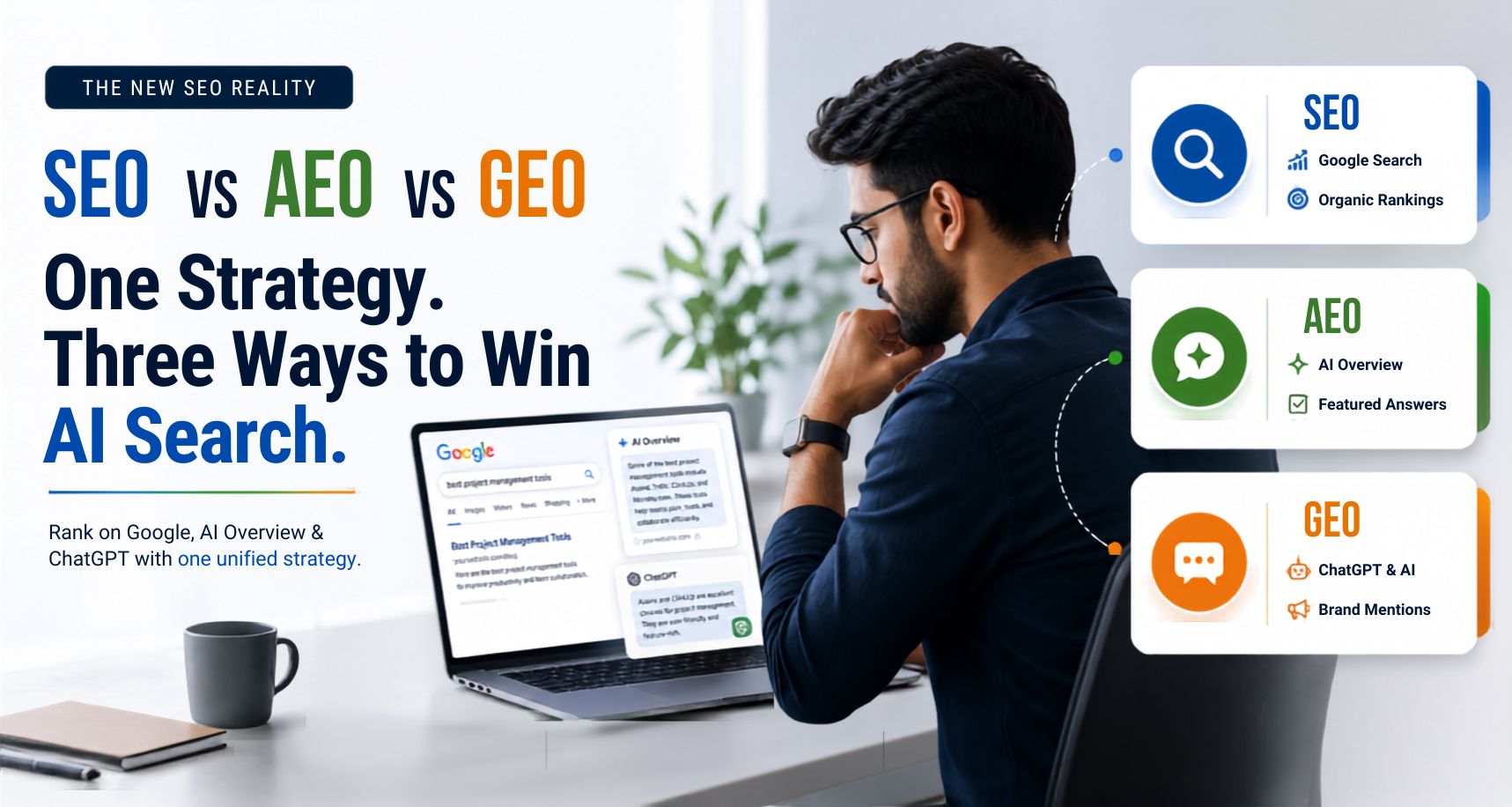
In 2026, this very formula is broken into three parts. The first part is the traditional Google search, where 40% of your potential traffic comes from. Second in line are AI Chatboxes like ChatGPT and Claude, which are responsible for up to 35% of potential traffic. And last but not least, we have AI-generated answer snippets on Google and other search engines or platforms, which drive 25% of potential traffic to your site.
Not just that, the uncomfortable fact is that you can be at the top of Google and completely invisible in ChatGPT. You cannot focus on just featuring on snippets and ignore LLMs. If you put all of your effort into inviting traffic on AI chatboxes, it can cost you the traffic coming from google searches.
The real escape from this problem? Understanding the difference between SEO, AEO, and GEO before building a strategy that rules over all three simultaneously.
This guide will walk you through how to achieve this goal, so you can rank high across all three sections.
The Three-layered Framework
Let's understand the clear comparison between the original and the latest status:
SEO (search engine optimization)- The Original (1998-2024)
Search Engine Optimization simply means getting your website to earn a high rank on search engines like Google’s results page.
This whole process happens when Google crawls your site and then analyses over 200 factors that help in ranking your website. After all that, your website pops up on the results page, and the user clicks your link.
For example, someone types out “best ways to bake bread” into their search engine. Your blog post ranks number one in the search engines, hence becoming the first item on their list. The user clicks on the link and proceeds to go through the contents of your article. After that, the user registers for more recipes. This is how SEO works!
2026 Status: SEO no longer works the way it used to before 2026. Google is one of the major sources of traffic, but a good fraction of searches is now answered directly by AI snippets before a user ever reaches a result page. This resulted in SEO’s overall visibility getting lower, even though the channel itself isn't disappearing.
AEO (Answer Engine Optimization) - The New Layer
AEO aims to get your content selected for the direct answer inside AI-driven search results.
When someone types a question into Google, the AI Overview System searches the web for the page that offers the clearest answer to the question and then pulls the relevant information directly from the page. The answer is shown right at the top of the results page, before any of the regular blue links, which often gives users what they need to know without clicking anything at all.
For example, imagine someone searching “What is the best bread for toast?” Rather than scrolling through search results, they see Google's AI Overview (results from Gemini) at the top of the page, showing content pulled directly from your FAQ, with your brand and a short snippet displayed alongside it.
While some users will find their answer there and never return to your page, others will click through to read more on your website. Regardless of either way, your brand made an impression.
2026 status: The AEO channel is evolving quickly. With over 156?option over the last year, Google is pushing AI Overviews into more and more searches. This means that more of your traffic is moving through this extraction-based model rather than traditional clicks.
GEO (Generative Engine Optimization) - The Communicative Layer
It is about earning a place in the actual conversations. Rather than showing up in a list of links or a snippet box, your brand gets mentioned by name when someone asks a large chat model like ChatGPT, Claude, or Gemini a related question.
You can think of it as if a knowledgeable friend were making the recommendation directly.
For example, picture a user asking ChatGPT, “What bread to use for avocado toast?” They get a conversational answer about “What bread pairs well with what dish?” Your brand appears with its name, within context, and a reason to consider it.
2026 status: The GEO channel is expanding rapidly by a very broad margin, with citation activity going up 340% every year. As more people are depending on AI assistance for suggestions instead of running a traditional search, being mentioned in these conversations means quickly getting one of the most valuable forms of visibility a brand can earn.

SEO vs AEO vs GEO: Side-by-Side Comparison
Google is no longer the only way for people to find answers. SEO, AEO, and GEO connect you with searchers in different ways, whether they are typing into a search bar, looking at a featured snippet, or asking an AI chatbot a question.
Understanding how they're different is the first step to making sure your brand shows up everywhere your customers are searching.
|
Factor |
Traditional SEO |
Answer Engine Optimization (AEO) |
Generative Engine Optimization (GEO) |
|
What you're optimizing for |
Ranking position (1st, 2nd, 3rd) |
Featured answer extraction |
LLM citation and recommendation |
|
Who controls results |
Google's algorithm |
The AI Overview system |
LLM training data |
|
Content requirements |
Long-form (2,000+ words) |
Structured, direct answers |
Authority plus specific data |
|
Update frequency |
Monthly to quarterly |
Real-time indexing |
Continuous, tied to training data |
|
Time to results |
3–6 months |
2–4 weeks |
4–8 weeks |
|
Trust signals |
Backlinks, domain authority |
Recency, specificity |
Author credentials, original research |
|
Example success |
Blog post ranking #1 for "best CRM" |
FAQ: surfacing your exact pricing |
ChatGPT is recommending your product |
|
Traffic quality |
High (intent-matched) |
Medium (snippet viewers) |
High (already in research mode) |
|
Best for |
Evergreen content, brand building |
Quick answers, FAQ pages |
Thought leadership, data-rich content |
The key difference is that SEO helps you get found on Google, AEO gets your answers featured, and GEO gets you noticed by AI chatbots like ChatGPT. None of them replace the others, but they work together and make sure your brand shows up no matter how your customers choose to search.
Understanding AEO vs SEO
AEO and SEO work together hand in hand. They are not enemies. Let's understand this comparison with examples:
Company A- This company uses only SEO and a 2024 strategy.
They invest ?3,00,000/month in SEO and end up ranking #1-3 for 15 keywords. Their link gets 8,000 monthly clicks from Google, but they are invisible in ChatGPT and Google AI Overview.
Their total monthly influenced traffic is 8,000.
Company B- This company uses SEO + AEO + GEO, 2026 strategy.
They invest ?3,00,000/month across all three channels and end up ranking #2-4 for the same 15 keywords (slightly lower).
Their link gets 6,500 monthly clicks from Google, is cited 280 times monthly in ChatGPT (approximately 2,100 influenced searches), and is mentioned 89 times in Google AI Overview (approximately 1,200 influenced clicks).
Their total monthly influenced traffic is 9,800
Company B generates 22% more total traffic with the same budget of ?3,00,000/month by just spreading across multiple channels.
Practical Strategies
Traditional SEO, AEO, and ranking in AI Overviews need planning to achieve. These are the practical strategies to keep your site visible in search:
Strategy #1 Traditional SEO
What Still Works:
There are a few things that will still help you hit that bull's eye, and those are as follows:
- Thorough, high-quality content. Remember, 2,000-3,000 words is still a sweet spot.
- A solid backlink profile with top-3 ranking pages averages 8-12 referring domains.
- Fast page speed and mobile optimization.
- A clear internal linking structure.
- Keyword targeting, though less aggressively than in 2020.
What has changed:
Let’s understand how 2026 brings a new perspective to SEO:
- Content volume alone no longer cuts it, as authority carries more weight now.
- Topical authority now outperforms single-keyword targeting.
- User experience signals matter as much as keyword matching.
- Brand mentions are now a ranking factor, not just backlinks.
Strategy #2: How AEO Supports Your SEO Strategy
AEO has not replaced SEO. Rather, it's an additional layer on top. Think of it like icing on the cake. It simply aims to get your answer pulled directly into AI Overviews.
What tactics work:
- Create FAQ pages based on 20-30 direct answers to questions.
- Start with hard facts such as numbers and dates.
- Create comparison tables if something is complicated.
- Use schema markup so that it can be easily analyzed by AI algorithms.
- Refresh information often, since AI favours recency over outdated information.
AEO pushes content that’s specific, extractable, and immediately useful.
For example, let's see the difference between the traditional and the AEO-optimized FAQ
|
Traditional FAQ: Q: What's the cost of a CRM? A: CRM pricing varies depending on many factors. Every business is different and has unique needs. Most companies find a solution that works for them through consultation. This won't get featured in the AI overview. |
|
AEO-optimized FAQ Q: Which CRM has the best price-to-features ratio? A: For small teams (less than 10 members): HubSpot Free/Pipedrive, which costs around ?900-1,200 per user. For growing teams (between 10 and 50 members): Monday Sales CRM or Freshworks, which will cost you approximately ?1,500-2,500 per user. See the difference? AEO is about extractable, specific, and helpful information. Now, this will surely get featured in the AI overview. |
Strategy #3: How To Rank In AI Overviews
If AEO is the layer, ranking inside AI Overviews is where that work pays off. Here's the practical roadmap for getting featured:
Step 1: Answer the exact question being asked. Don't make your readers go through a whole paragraph to find an answer. It should be straight to the point.
Step 2: Use structured data (Schema markup). By structuring your content in this way, it is easier for Google's AI to understand and extract your content.
Step 3: Include tables and lists. The AI Overviews value structured content, and this is why tables are preferred over paragraphs.
Step 4: Update regularly. AI Overviews put emphasis on new information, so include publication and revision dates, and make sure you update your most important pages at least once a quarter.
Here's what that looks like in practice. When someone searches "How much does a CRM cost?", this is how your well-organized page would feed Google's AI Overview:
CRM software pricing varies from ?0 to ?10,000+ per user/month, depending on the supplier and the requirements.
Free Options:
- HubSpot CRM: offers a free plan with basic functionality
- Zoho CRM: 14-day free trial offered
Paid Plans:
- Pipedrive: ?890/user/month (starter plan)
- Freshworks: ?1,500/user/month (growth plan)
- Salesforce: ?5,000+/user/month (custom enterprise pricing)
Did you notice what’s going on? The AI Overview pulls exact figures, specifies particular choices, and cites the source page. It’s the combination of answering the question directly, organizing data, and being specific that gets pages featured.
The Adomantra Approach
Here's how we help brands win across SEO, AEO, and GEO simultaneously, rather than treating them as three separate projects.
Phase 1: Diagnostic Audit (Week 1)
To begin with, we will map out your exact positioning on all three channels:
- Your current Google rankings (SEO performance)
- Your presence in AI Overviews (AEO tracking)
- How often does ChatGPT cite you (GEO baseline)
- How competitors are performing across all three
- The content gaps keeping you out of AI-driven results
Output: A clear picture of exactly where you're winning and losing across every channel.
Phase 2: Strategic Rebuild (Weeks 2-6)
From there, we restructure your existing content to work across all three at once:
- SEO for Google: Keep the content that works and improve authority signals.
- AEO for AI Overviews: Incorporate structured answers, FAQ optimization, and schema markup in your content.
- GEO for ChatGPT: Rebuild the content to be information-rich, authoritative, and cite-worthy.
Phase 3: Authority Building (Weeks 7-12)
Once the foundation is in place, we focus on making you the source AI platforms actually want to cite:
- Placing thought leadership content.
- Building out author credentials.
- Producing original research.
- Establishing your brand as a trusted reference point across the web.
At Adomatra, we help brands build content that works everywhere it matters. From technical SEO and keyword strategy to structuring content that AI engines can easily read, summarize, and cite. Whether someone's searching on Google, asking an AI Overview, or chatting with ChatGPT, we make sure your business shows up.
Final Thoughts
SEO, AEO, and GEO aren't competing strategies. There are three channels of the same conversation with your customers.
Your audience is:
- Googling questions (SEO opportunity)
- Asking ChatGPT for recommendations (GEO opportunity)
- Looking for quick answers in AI Overviews (AEO opportunity)
The companies that win in 2026 won't be good at just one channel; they'll be good at all three. Skipping even one channel is a big mistake, because it means losing all the people who like using that channel.
The good news is that these three channels don't fight each other. Rather, they work together. One good piece of content that is clear and gives the answer right away, backed by facts, easy to skim, and can show up on Google, in an AI Overview, and on ChatGPT, all at the same time. You don't need three different plans. You just need one good one.
FAQ
Q1: Do I need to choose one between SEO, AEO, or GEO? Or should I do all three?
A: Do all three. Roughly 40% of users browse on Google, 35% use ChatGPT first, and 25% use AI Overviews. By leaving out any one of these options, you are neglecting one portion of your potential clients. Just as social media involves using not just Facebook but also Instagram and LinkedIn, so too is there an advantage to building one piece of content for all three.
Q2: How is AEO different from SEO in terms of content creation?
A: Content for SEO must be ranked along with keywords and links, whereas content for AEO must be extractable, short, and structured as Q&A and tables. For example, the SEO content may be “Ultimate Guide” that is 3,500 words long, while the AEO content may be “Pricing Comparison” of 1,200 words with some charts.
Q3: What's the difference between SEO and GEO in terms of ranking timeline?
A: It takes around three to six months for SEO, as it involves three steps, including crawling, indexing, and ranking. However, GEO is relatively quick as it requires 4 to 8 weeks, and the citation usually starts showing in the 3rd-4th week and gets stabilized in the 8th-12th week.
The reason behind its speediness is that AI models get updated more frequently.
Q4: How do I measure success in Answer Engine Optimization (AEO)?
A: Three key metrics are featured snippet appearances (aim for 10-15, tracked via Search Console), AI Overview traffic (usually 15-30% of existing traffic), and brand lift from visibility even without clicks. A good benchmark is usually somewhere between 15 and 25 AI Overview appearances within 8 weeks.
Q5: Does Generative Engine Optimization (GEO) affect my Google SEO?
A: No, not directly. However, this is indirectly helped by author authority, original research, and new content. Think of SEO and GEO like Google vs. TikTok; they both have different audiences, which means no conflict, just separate wins.
Q6: My competitor ranks #1 on Google but doesn't appear in ChatGPT at all. Should I copy their strategy?
A: Not necessarily. You could compete for the same position at Google or succeed in areas where your competitors are not. ChatGPT and AI Overviews have lower competition. Establishing an early geographic (GEO) presence can lead to reduced acquisition costs now and provide a strong advantage when GEO areas become more competitive.