5 Simple Tips to Increase the Conversion Rate for Your Website in 2026
If you worry about the low conversion rate of your website, you have come to the right place. First of all, you need not worry as even the famous sites struggle to reach the average conversion rate of 2%. The conversion rate formula of 2% is only 2 out of 100 visitors to your site become your customer or perform any of your call to action. Visitors take only a few seconds to stay on the site and, once convinced, wait longer to have more conversions. So conversion optimization is the major contributor for any business to sustain and succeed.
Hence, check out the importance of conversion rate optimization and five simple tips to increase your website's conversion rate and develop your business to new heights.
The Importance of Increasing the Conversion Rate Optimization for Websites
In this digital business world, conversion rates are as low as 0.1 to 0.2 percent, crucial for measuring growth. Hence, it is critical to increase conversion rate optimization as it is the foundation for higher sales volume and thus higher revenue and profits. Also, knowing the success of marketing campaigns and their ROI becomes much clearer when you track your conversion rate consistently.
Five Simple Tips to Increase the Conversion Rate Optimization for Websites
Having known the importance of lead conversion that could make or break a business, it is time for you to know five simple tips to increase the conversion rate for your websites that include:
1. Remove the Barriers of Conversion in the Site
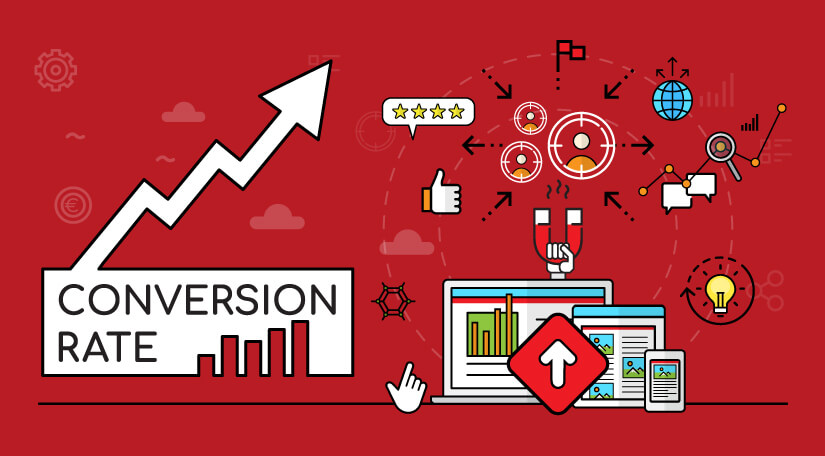
The first tip is to remove the barriers that could prevent the visitors from converting. For example, if the site has too many places to look for, visitors have analysis paralysis, which is getting confused about making a decision. Hence, they leave the site without converting, such as buying the products, filling the form, booking a demo, clicking CTA, signing a letter, etc. Hence it is essential to have the site with minimal barriers not to get the visitor confused but go right to the place for getting converted to do any of the actions mentioned above to be a prosperous consumer or purchase to become a trusted customer.
Have a goal for the site

If the first tip is to remove the barriers, the second is to have a goal for the site as it will automatically do it. There should be a need for the business goal, which is the primary action that the visitor needs to take on the site. Having a plan makes it easy to evaluate the site to know how effective it is in achieving it. Not having an incredible goal will make it impossible to measure the conversion rate and improve the site with better marketing and SEO practices. The goal in the site should not be about only knowing the products but with a call to action like "buy," "sign-up," "fill the form," "click," etc.
Analyze audience interaction with the site

Most sites have lower conversion rates because of their poor web design and UX or user experience. Hence, it becomes essential to analyze the audience interaction in the site to know the more potent and weaker points. For example, knowing how long the visitors stay on a particular place or page will determine its positivity, and skipping the ones within seconds will show the negativity. Hence, improving the positive pages, correcting the hostile areas, and having seamless and easy UX will help improve the conversion rate.
Add a pop-up to the site
Use many pop-up styles that could attract the visitors to click or press for converting to customers. While they navigate the page with easy UX, only the right pop-up for the call to action will instantly attract them to click or press it. It should be so that the visitors have no problems finding them as even searching for them may make them leave the site without converting. Call to action like "Get it now," and others should be prominently placed with attractive colors different from the other site content to convert visitors to customers.
Make the site mobile-friendly.

With over half the population having mobile phones, it is essential to make the site mobile-friendly to improve the conversion rates. Also, it is essential to make it with responsive design, larger fonts, and thumb-friendly for increasing the conversion rate.
The above tips will confidently help to improve your conversion rate optimization for developing your business.
Frequently Asked Questions About Conversion Rate Optimization
Q1. What is a good conversion rate for a website?
A good website conversion rate varies by industry, but the average across most sectors is between 2% and 5%. E-commerce sites typically see 1% to 3%, while lead generation pages can achieve 5% to 10% with strong optimization. If your conversion rate is below 2%, implementing conversion rate optimization (CRO) strategies can significantly improve results.
Q2. How do I calculate my website's conversion rate?
Conversion rate is calculated by dividing the number of conversions (desired actions completed) by the total number of visitors, then multiplying by 100. For example, if your site had 10,000 visitors and 200 made a purchase, your conversion rate is 2%. Tools like Google Analytics make this calculation automatic and track it in real time.
Q3. What is the most effective way to increase website conversion rate?
The most effective single change is usually improving your call-to-action (CTA) — making it more visible, specific, and compelling. Beyond that, removing unnecessary steps from the conversion path, improving page load speed, adding social proof like reviews and testimonials, and ensuring mobile-friendliness consistently deliver strong conversion rate improvements.
Q4. What is analysis paralysis and how does it affect conversions?
Analysis paralysis occurs when a website offers too many choices or too much information, causing visitors to feel overwhelmed and leave without taking any action. Simplifying your site's navigation, reducing the number of CTAs per page to one primary action, and creating a clear visual hierarchy helps guide visitors toward conversion without confusion.
Q5. How does mobile-friendliness affect conversion rates?
With over 60% of web traffic now coming from mobile devices, a site that is not mobile-optimised will lose a significant portion of potential conversions. Mobile-friendly design includes responsive layouts, larger tap targets, faster load times, and easy-to-complete forms — all of which directly improve the experience for mobile users and increase conversion rates.
Conclusion
Improving your website's conversion rate does not require a complete overhaul — small, focused changes can make a significant difference. By removing conversion barriers, setting a clear site goal, analyzing how your audience interacts with your pages, using well-placed pop-ups, and ensuring your site is mobile-friendly, you give every visitor a better chance of taking the action you want.
Start with one tip, measure the impact, and build from there. Consistent optimization over time is what separates high-converting websites from the rest.
If you need expert help improving your website's conversion rate, get in touch with Adomantra today for a free audit.