Are You Ready for the Next Era of Ads? Your Strategy Can Make All the Difference in 2026
In today's advertising arena, it's not enough to just play the game — you've got to win it. With brands battling for attention in an ever-crowded, fast-paced digital and physical world, choosing the right ad-buying strategy can be the difference between a campaign that just works and one that becomes legendary. So, what's the ultimate weapon in your advertising arsenal? The question on every marketer's mind: traditional media buying or programmatic ad buying?
Traditional media buying is the tried-and-true heavyweight — decades of experience behind it, with TV spots, radio ads, and print campaigns that are timeless in their ability to reach vast audiences. The global TV advertising market is projected to reach $145 billion by 2026 — proving that traditional media still commands enormous budgets and audience attention globally.
But stepping firmly into the spotlight in 2026 is programmatic ad buying. Powered by AI, data, and real-time bidding, programmatic now accounts for over 90% of all digital display advertising globally — representing a market worth over $725 billion. It is fast, targeted, and gives advertisers unprecedented control over every aspect of their campaign. The real question is: which one packs the bigger punch for your brand? And is the answer the same in 2026 as it was even two years ago?
Let's dive into this head-to-head comparison and find out.
Programmatic Ad Buying — Precision Meets Performance
Imagine having an intelligent assistant working tirelessly to ensure your ads land in front of the perfect audience at the perfect moment — and continuously learning and optimising to make each impression more effective than the last. That is programmatic ad buying in 2026.
By leveraging cutting-edge AI, machine learning, and real-time automation, programmatic platforms take the manual effort out of purchasing ad space — making the process faster, smarter, and more precise than any human-managed media buying process could be. In 2026, AI-powered programmatic systems don't just execute bidding instructions; they independently identify optimal audience segments, predict conversion probability for each impression, and dynamically reallocate budget across channels based on live performance signals.
With programmatic media buying, you are not just placing ads — you are orchestrating campaigns that deliver maximum impact across display, video, Connected TV (CTV), digital audio, native, and digital out-of-home (DOOH) from a single platform. It is a seamless blend of data, creativity, and automated strategy that ensures every rupee spent works harder for your business.
Key programmatic capabilities in 2026:
- Real-time bidding (RTB): Automated auction of individual ad impressions in milliseconds — buying only the most relevant audience exposures
- AI-powered optimisation: Machine learning continuously adjusts bids, targeting, and creative selection based on live performance data
- Cross-channel reach: Unified buying across display, video, CTV, mobile, audio, native, and DOOH from one platform
- Attention-based buying: Advanced programmatic strategies in 2026 target environments where audiences are genuinely engaged — not just where impressions are technically visible
- Privacy-first targeting: First-party data activation, contextual targeting, and privacy-safe audience matching solutions that comply with India's DPDPA regulations
To understand the full mechanics of how this technology works, explore our complete guide on what programmatic advertising is and how it works — covering RTB, DSPs, SSPs, and every major deal type in 2026.
Traditional Media Buying — A Classic Approach with Staying Power
While programmatic buying may be the dominant force in digital advertising, traditional media buying still plays a significant and valuable role in the overall marketing mix — particularly for building broad brand awareness, reaching offline audiences, and creating tangible, high-trust brand moments that digital alone cannot replicate.
Think of the enduring impact of TV commercials that embed themselves in cultural memory, radio jingles that stick for decades, or a billboard in a premium location that thousands of commuters see every single day. These formats rely on human expertise, editorial negotiation, and creative impact — making them ideal for brands that want to connect with mass audiences in memorable, authoritative ways.
Traditional media offers:
- Broad reach: TV, radio, and print campaigns reach mass audiences simultaneously — ideal for building widespread brand awareness in a single campaign burst
- Physical impact: Formats like large-format outdoor advertising, premium print placements, and broadcast TV leave lasting impressions that digital ads scrolled past in a feed cannot match
- Established trust: Audiences often ascribe greater credibility to brands they see advertised in premium traditional media environments — particularly in categories like healthcare, finance, and FMCG
- Consistency: Pre-planned placements ensure your messaging runs precisely as scheduled without the variability of auction-based buying
- Offline audience capture: Reaches consumers who are not active in digital environments — critical for categories serving older demographics or rural audiences in India
The Big Debate — Programmatic Buying vs. Traditional Media Buying in 2026
Let's look at how these two approaches compare across the metrics that matter most for modern advertisers:
| Dimension | Traditional Media Buying | Programmatic Ad Buying (2026) |
|---|---|---|
| Speed and Agility | Weeks of lead time for negotiations, bookings, and creative approvals | Campaigns live within hours; real-time adjustments at any point |
| Audience Targeting | Broad, context-based (publication, channel, time slot) | Precise, individual-level targeting by behaviour, intent, location, and first-party data |
| Performance Data | Post-campaign audience estimates and surveys | Real-time impression-level analytics and attribution |
| Cost Efficiency | Higher upfront costs; less adaptable to performance signals | Pay for precisely the impressions you want; AI optimises toward best-performing placements |
| Optimisation | Fixed placements — limited mid-campaign adjustments | Continuous AI-driven optimisation throughout campaign lifecycle |
| Brand Safety | High editorial control in premium publications and broadcast | Requires active brand safety management — PMPs and verification tools essential |
| Creative Formats | TV, radio, print, outdoor, cinema | Display, video, CTV, audio, native, DOOH — plus interactive and dynamic formats |
| Minimum Investment | Often high — particularly for broadcast TV and premium print | Accessible at various budget levels; scalable from small to enterprise |
| Best For | Mass brand awareness, cultural moments, offline audiences | Precision targeting, performance campaigns, ROI-accountable digital reach |
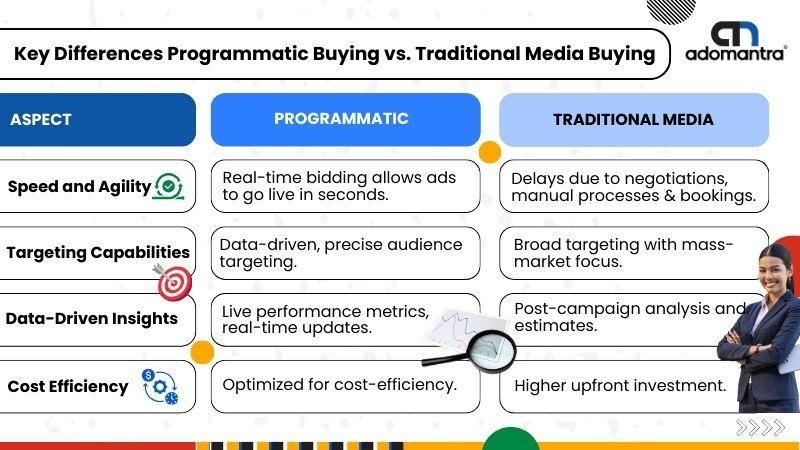
- Speed and Agility: Programmatic buying operates at lightning speed — using real-time bidding to get campaigns live within hours and allowing instant adjustments based on performance. Traditional buying involves longer timelines, from negotiations and creative approvals to booking confirmations and airing schedules.
- Targeting Capabilities: With programmatic advertising, you can reach niche audiences using advanced data — from browsing behaviour and purchase intent signals to first-party CRM audience segments. Traditional buying targets by broad context (the readership of a publication, the viewership of a TV programme) rather than by individual audience profile.
- Data-Driven Insights: Programmatic campaigns provide live performance metrics — impressions, viewability, clicks, conversions, and ROAS — allowing real-time campaign adjustment. Traditional media typically relies on post-campaign audience surveys, panel-based ratings, and circulation estimates that take weeks to arrive.
- Cost Efficiency: Programmatic ensures every impression is evaluated for relevance before being purchased — eliminating significant waste from reaching irrelevant audiences. Traditional media typically demands higher upfront investments with less flexibility to optimise mid-campaign.
Ads That Work While You Sleep — The Programmatic Advantage
At Adomantra, we have witnessed first-hand how programmatic ad buying transforms businesses across industries and budget levels. The power of programmatic in 2026 is not just automation — it is the combination of scale, precision, and continuous AI-driven improvement that delivers compounding results over time.
With programmatic media buying, you can:
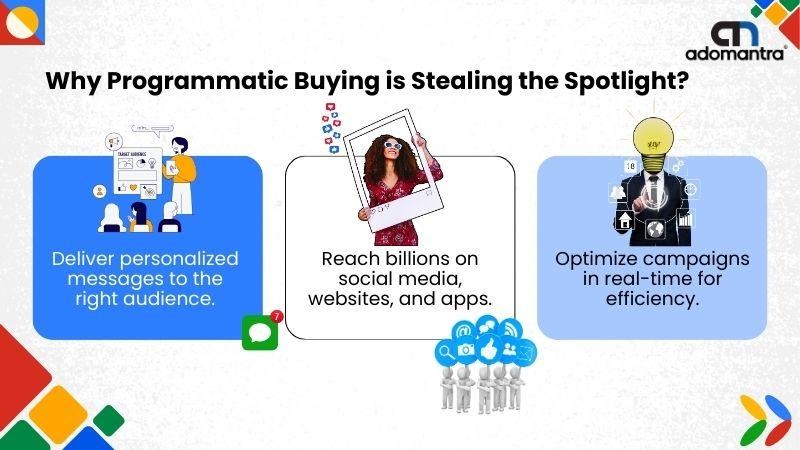
- Send personalised messages to the right audience at exactly the right moment in their purchase journey — across every screen they use
- Reach millions across websites, mobile apps, streaming platforms, and smart TVs — with a single unified campaign strategy
- Optimise campaigns in real time based on which placements, audiences, and creatives are driving the best results — saving both time and budget automatically
- Access premium, brand-safe inventory through Private Marketplace deals with trusted publishers — combining programmatic efficiency with editorial quality
- Measure every impression, click, and conversion with attribution clarity that traditional media simply cannot match
In 2026, the rise of attention-based buying in programmatic advertising has further elevated performance — allowing brands to specifically target ad environments where audiences are most actively engaged, not just where impressions are cheapest. This shift from viewability to genuine attention is producing measurably better brand outcomes for equivalent budgets.
This isn't just the future — it is the present reality, and your brand needs to be part of it.
When Traditional Media Still Shines
Do not count out traditional media just yet. Despite the dominance of programmatic in digital channels, traditional media retains genuine, irreplaceable strengths — particularly in specific industries, audiences, and campaign objectives.
For industries like healthcare, retail, hospitality, and FMCG, formats like TV ads, radio, and premium print can make a significant and lasting impact. Traditional media excels in:
- Building trust and authority within local and regional markets: Appearing in well-known local newspapers, radio stations, or regional TV channels signals established credibility that resonates particularly strongly in smaller cities and towns across India
- Capturing offline audiences who are not active digitally: Large segments of India's population — particularly in tier 2, 3, and rural markets — are primarily reached through television, radio, and print rather than digital channels
- Creating tangible, high-impact marketing moments: A full-page newspaper advertisement, a prime-time TV commercial during a major sporting event, or a premium billboard in a high-traffic location create brand presence that feels different — more substantial, more credible, more permanent
- Regulatory and cultural contexts: In certain categories (pharmaceuticals, financial services, government communications), traditional media formats carry specific regulatory advantages and audience trust levels that digital cannot replicate
Blending the Best of Both Worlds — The 2026 Hybrid Strategy
The most sophisticated and successful advertisers in 2026 have moved beyond the binary choice of programmatic versus traditional. The question is no longer "which one?" — it's "how do you orchestrate both for maximum combined impact?"
A well-designed hybrid strategy combines the trust, reach, and cultural impact of traditional media with the precision, efficiency, and measurability of programmatic digital advertising — creating a coordinated brand presence that reaches audiences across every touchpoint in their daily lives.
How a hybrid strategy works in practice:
- Use TV, radio, and outdoor advertising to establish broad brand identity and mass awareness — seeding your brand message at scale
- Retarget those same exposed audiences online with programmatic ads that drive specific actions — directing brand-aware users toward conversion
- Use programmatic CTV advertising to extend your TV campaign's reach to streaming audiences that linear TV misses — on the same screen, in the same lean-back viewing environment
- Employ programmatic native and display to reinforce messaging for audiences reached through print — maintaining continuity across their digital and physical information consumption
- Measure the combined impact through unified attribution models that account for both digital conversion signals and brand lift from traditional exposure
At Adomantra, we specialise in creating multi-channel campaigns that work in harmony — delivering consistent brand visibility and unmatched results by leveraging each medium for what it does best. Understanding how programmatic advertising compares to other digital buying approaches like Google Display Network is one important step in building an intelligent, integrated media strategy.
It's Time to Supercharge Your Advertising with Adomantra
The choice between programmatic and traditional is not a battle — it is an opportunity to blend the best of both worlds with strategic intelligence. In 2026, the brands winning in their categories are not those that picked one approach and abandoned the other — they are the ones who understand the strengths of each medium and deploy them in a coordinated, data-informed way.
At Adomantra, we are here to guide you through the perfect fusion of innovation and tradition — crafting campaigns that deliver real, measurable results regardless of where your audience lives, how they consume content, or what stage of the buying journey they are in.
Whether you want to supercharge your brand with the power of AI-driven programmatic automation, amplify your classic traditional approach, or build an integrated strategy that combines both — we are your partners in advertising success.
Let's create something extraordinary together.
Get your free advertising strategy audit from Adomantra today ?
Or contact us directly at +91-931-166-9643 to speak with our programmatic and media buying specialists about your specific advertising objectives.
Adomantra — Building Stronger Digital Presences Since 2012
Frequently Asked Questions — Programmatic Buying Made Simple
Q: Can programmatic ads work for niche B2B markets?
A: Absolutely. With programmatic ad buying in 2026, you can target specific industries, job roles, company sizes, and even individual decision-makers with precisely tailored messaging — using LinkedIn audience data, first-party CRM segments, and intent-based targeting signals. At Adomantra, we customise programmatic campaigns for B2B clients across technology, manufacturing, financial services, and professional services — delivering qualified business audiences at scale.
Q: Is programmatic buying more cost-effective than traditional media?
A: In most digital advertising contexts, yes. Programmatic media buying ensures you pay only for impressions that match your defined audience criteria — eliminating the wasted reach that is inherent in broad traditional media placements. By continuously optimising toward the best-performing placements, Adomantra's programmatic campaigns consistently improve cost-per-outcome metrics over time, delivering stronger ROI than traditional approaches for digital-first campaign objectives.
Q: How quickly can I see results with programmatic campaigns?
A: Unlike traditional media, which often requires weeks between booking and results reporting, programmatic campaigns can deliver performance data within hours of launch. With real-time analytics, you can measure impressions, viewability, clicks, and conversions as they happen — and make optimisation decisions based on live data within days rather than waiting for post-campaign reports.
Q: Does traditional media still matter in a digital-first world in 2026?
A: Yes — particularly in India, where television reaches over 900 million viewers and radio remains a primary medium in tier 2, 3, and rural markets. Traditional media is especially valuable for building broad brand trust, reaching offline audiences, and creating high-impact cultural moments that digital alone cannot achieve. At Adomantra, we recommend an integrated approach that combines traditional brand-building with programmatic digital precision for most advertisers.
Q: How do I integrate programmatic buying into my existing campaigns?
A: Start by identifying which of your current campaign objectives — awareness, consideration, or conversion — would benefit most from programmatic's precision and measurability. Use programmatic ads to complement your traditional efforts initially — retargeting audiences reached through TV or outdoor, or capturing digital demand generated by brand awareness campaigns. Adomantra's team guides you through the entire integration process, ensuring seamless coordination between your traditional and programmatic channels for maximum combined impact.
Q: What is the minimum budget required to start with programmatic advertising in India?
A: There is no fixed minimum, but programmatic campaigns typically deliver the best efficiency at monthly budgets of ?1 lakh or above — allowing sufficient impression volume for AI optimisation to work effectively. Smaller budgets can start with programmatic, but tightly defined targeting and conservative channel selection are important to ensure meaningful reach. Adomantra advises on the appropriate budget allocation based on your specific objectives, target audience, and competitive landscape.